Topic B2 - Forces, Motion and Movement
IB SEHS 2026 Study Guide
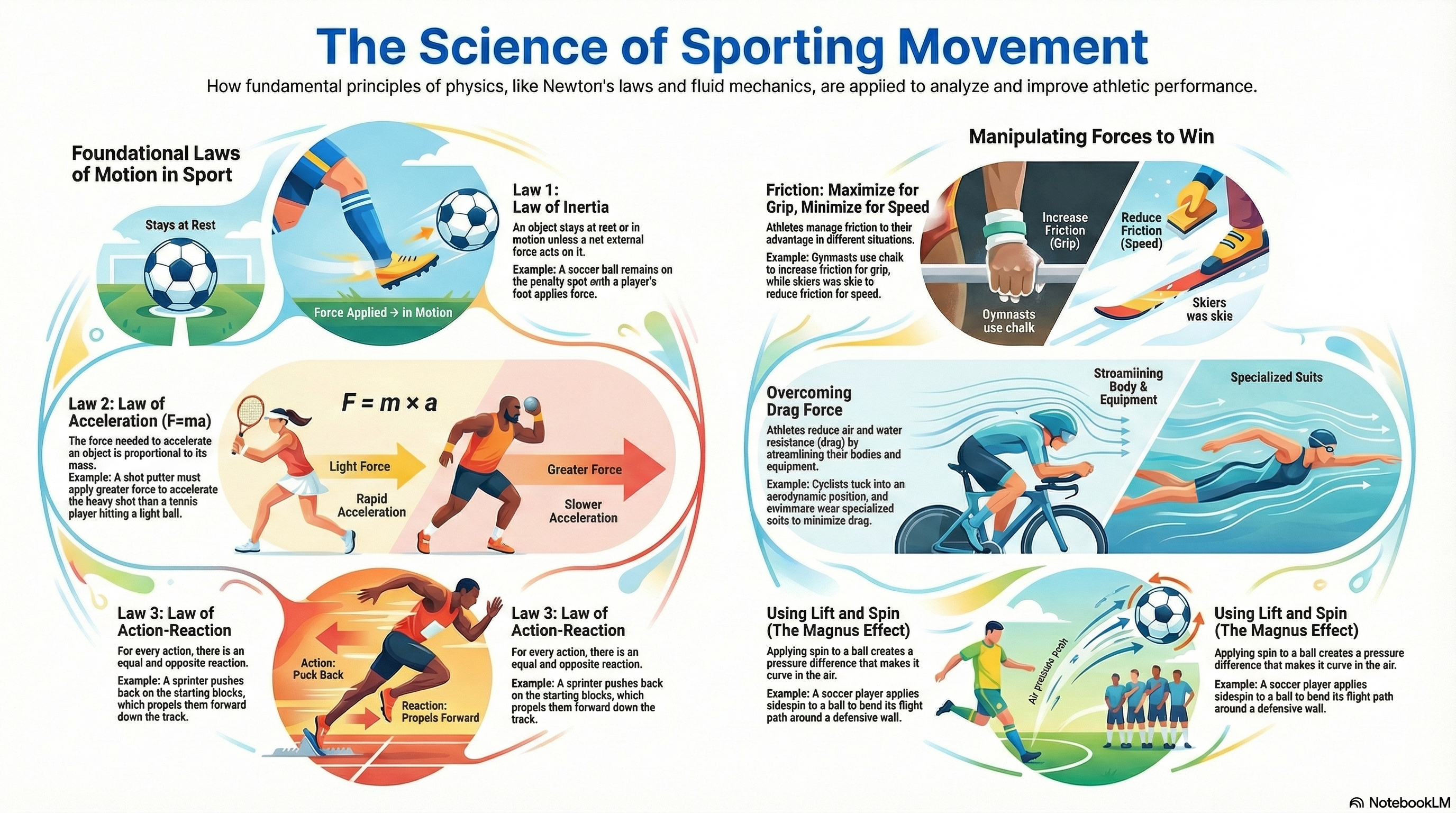
In the scientific study of biomechanics, precision in language is paramount. Vague terms like "power" or "force" carry specific mechanical definitions that are essential for accurate analysis. Understanding the following key terms is the foundational first step toward mastering the principles that govern all human movement, from a sprinter's start to a diver's rotation.
Understanding and accurately using these terms is the foundation for analyzing movement and answering biomechanics-related exam questions with precision.
To answer questions effectively, it is vital to recognize the specific "command terms" used in the exam, as they provide explicit instructions on the depth of response required.
| Command Term | IB Definition | Topic Example |
|---|---|---|
| State | Give a specific name, value or other brief answer without explanation or calculation. | State the principle of conservation of angular momentum. |
| Outline | Give a brief account or summary. | Outline the factors affecting the stability of an object. |
| Describe | Give a detailed account. | Describe the relationship between applied force and frictional force for an object starting from rest. |
| Explain | Give a detailed account including reasons or causes. | Explain how a swimmer can increase their rate of rotation during a somersault turn. |
| Analyse | Break down in order to bring out the essential elements or structure. | Analyse the data in Figure 13 showing the angular momentum of different body parts during a piked dive. |
| Evaluate | Make an appraisal by weighing up the strengths and limitations. | Evaluate the technique of drafting behind other competitors to improve performance in a cycling race. |
| Calculate | Obtain a numerical answer showing the relevant stages in the working. | Calculate Usain Bolt's average velocity between the 60 m and 70 m marks of his 100m race. |
Proficiency in SEHS requires you to be more than a theorist; you must be a quantitative scientist. This section outlines the essential mathematical skills needed to excel in biomechanics, from basic calculations to interpreting graphical data.
Units and Conversions
Q: Convert a velocity of 36 km h⁻¹ to m s⁻¹.
A:
1 km = 1000 m
1 hour = 3600 seconds
36 km h⁻¹ = 36 * (1000 m / 3600 s) = 36 * (1/3.6) m s⁻¹ = 10 m s⁻¹.
Using Formulas (e.g., F=ma, Power=Work/Time)
Q: A weightlifter lifts a 100 kg barbell 2 meters in 1.5 seconds. Calculate the power generated (g = 9.81 m s⁻²).
A:
Force (F) = mass (m) * acceleration due to gravity (g) = 100 kg * 9.81 m s⁻² = 981 N.
Work (W) = Force (F) * distance (d) = 981 N * 2 m = 1962 J.
Power (P) = Work (W) / time (t) = 1962 J / 1.5 s = 1308 W.
Calculating Averages and Percentages
Q: A swimmer completes 5 laps in 25s, 26s, 24s, 27s, and 23s. Calculate the average lap time and the percentage improvement from the slowest to the fastest lap.
A:
Average lap time = (25 + 26 + 24 + 27 + 23) / 5 = 125 / 5 = 25 seconds.
Slowest lap = 27s, Fastest lap = 23s.
Improvement = 27 - 23 = 4s.
Percentage improvement = (Improvement / Slowest lap) * 100 = (4 / 27) * 100 ≈ 14.8%.
Interpreting Graphs (e.g., Displacement-Time, Velocity-Time)
Q: Describe the motion of an object represented by a horizontal line on a velocity-time graph.
A: A horizontal line on a velocity-time graph indicates that the velocity is constant. Therefore, the object is moving at a constant speed in a constant direction, meaning it has zero acceleration.
Mastering these mathematical skills will enable you to confidently tackle quantitative problems and interpret data, which are critical for success in the SEHS examination.
Topic B2 is divided into three key areas: Newton's foundational laws that govern all motion, the interaction of athletes with fluids like air and water, and the systematic analysis of movement patterns to enhance performance. This section will deconstruct each area to build a comprehensive understanding of the mechanics of sport and exercise.
B2.1 Newton's Laws of Motion
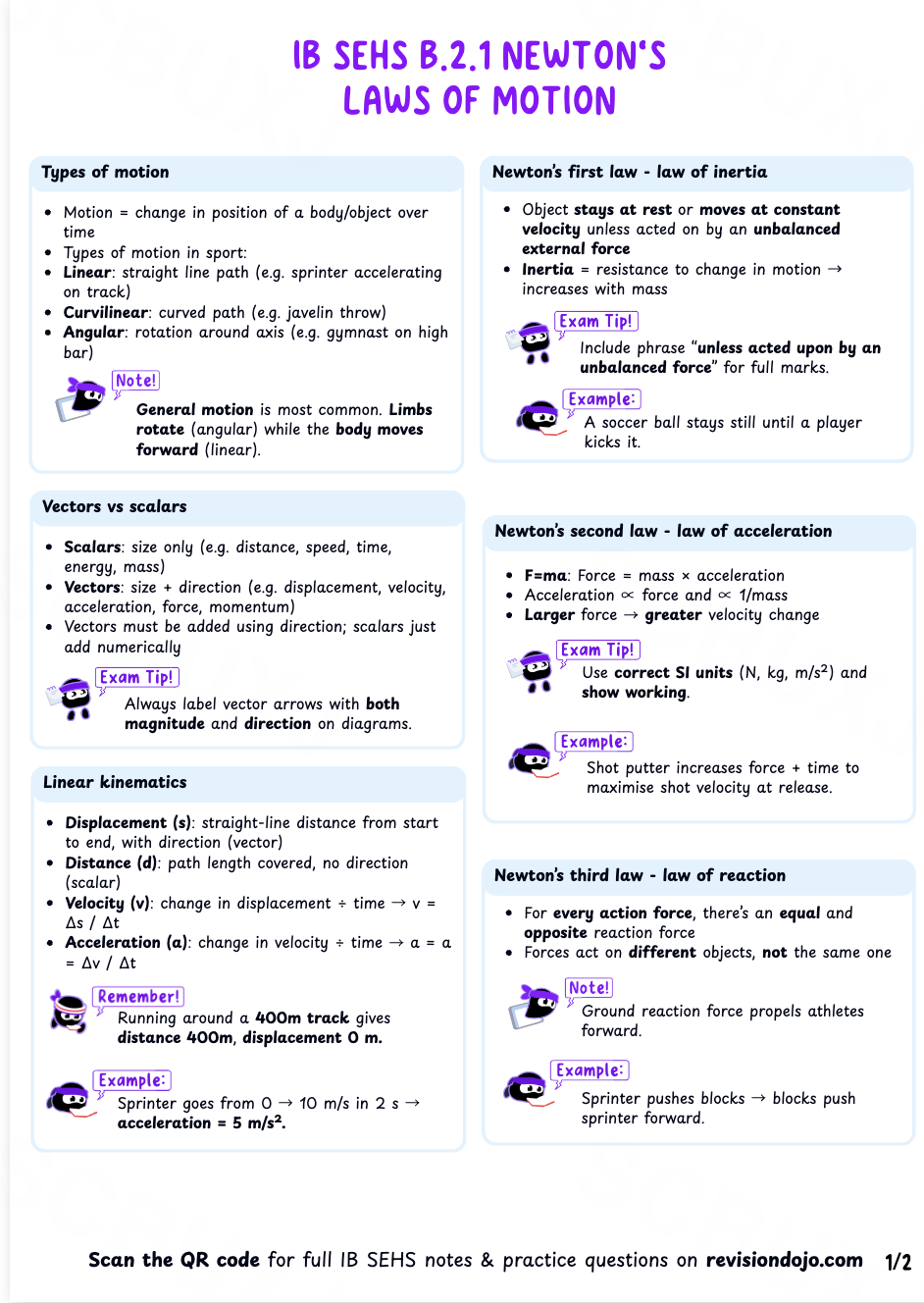
Sir Isaac Newton's three laws of motion are the bedrock of biomechanics. They provide a complete framework for understanding how forces create, change, and control movement in all sporting contexts, from the explosive start of a sprinter to the stability of a wrestler.
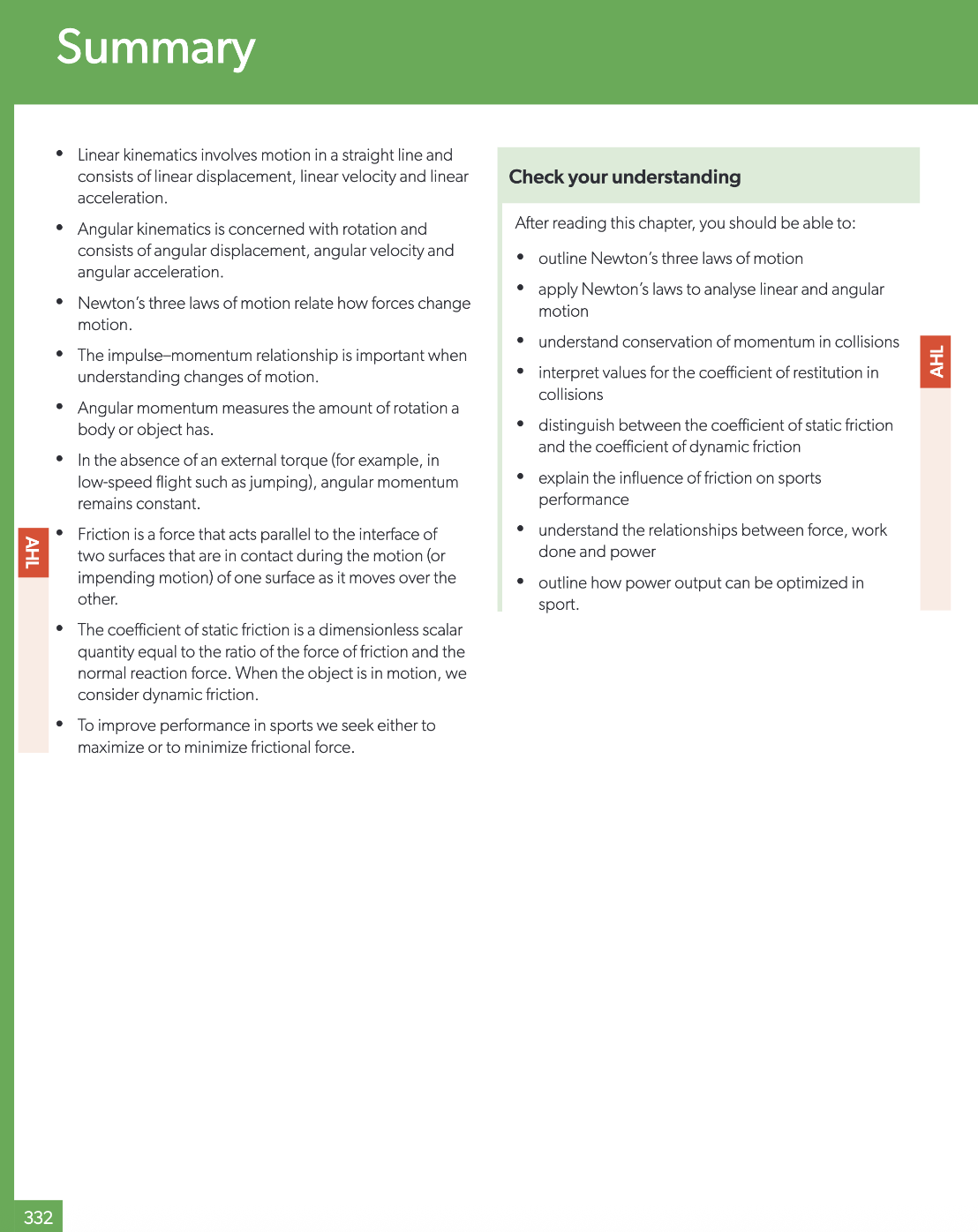
- Kinematics is the study of motion, including linear and angular displacement, velocity, and acceleration p.309-313.
- Newton's first law (Inertia): Bodies or objects stay at rest or in motion unless acted on by an unbalanced force p.315.
- Newton's second law (Acceleration): The acceleration of a body is proportional to the force causing it and in the same direction (F=ma) p.315-316.
- Newton's third law (Action-Reaction): For every action there is an equal and opposite reaction p.316.
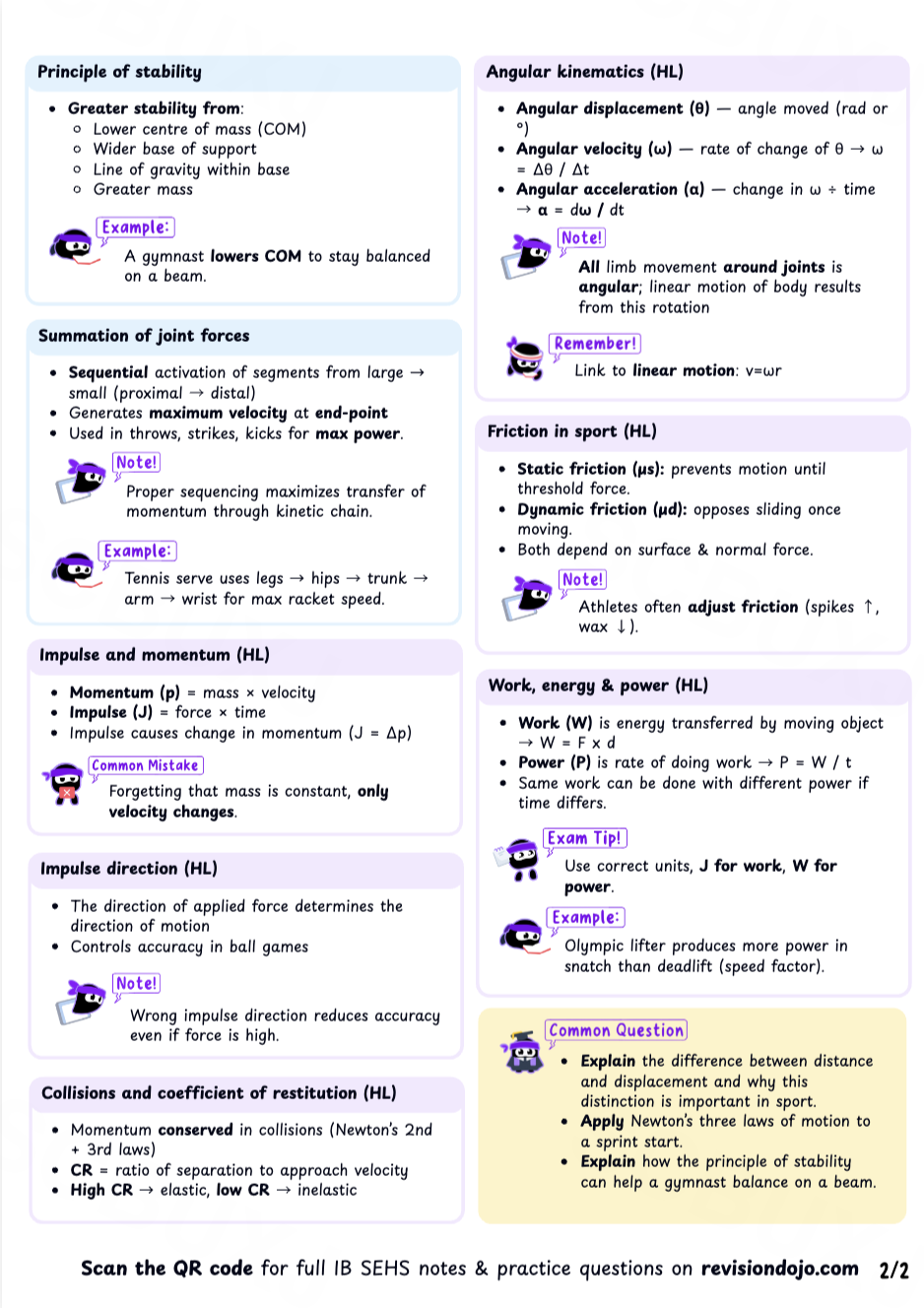
- Impulse is the change in momentum of an object (J = FΔt) and is critical for understanding how forces are applied over time p.319.
- Conservation of angular momentum states that angular momentum remains constant in the absence of an external torque, allowing athletes to control their rotation p.322.
- Friction is a force that acts between two surfaces in contact and can be static (not moving) or dynamic (moving) p.327-328.
To illustrate how Newton's Third Law works in sprinting:
- Action: A sprinter pushes backwards and downwards with large forces onto the starting blocks p.316.
- Reaction: According to Newton's third law, the blocks will push back on the sprinter with the same force, but in the opposite direction (forwards and upwards) p.316.
- Result: This reaction force is what propels the athlete out of the blocks and forwards down the track.
To maximize the power of a spike, a player uses the principle of summing joint forces. They sequentially generate force from their legs, torso, shoulder, and arm, culminating in a high velocity at the hand. This is an application of Newton's second law, where the combined force results in a massive acceleration of the ball p.319.
It is crucial not to confuse mass and weight. Mass is the amount of material in an object (measured in kg) and is constant. Weight is the force of gravity acting on that mass (Fg = mg) and changes depending on the gravitational field p.315.
B2.2 Fluid Mechanics
Once an athlete or object is in motion, they must contend with forces from the surrounding fluid (air or water). This section analyzes how these forces—drag, lift, and buoyancy—affect performance and how athletes have developed techniques and technologies to manipulate them for a competitive advantage.
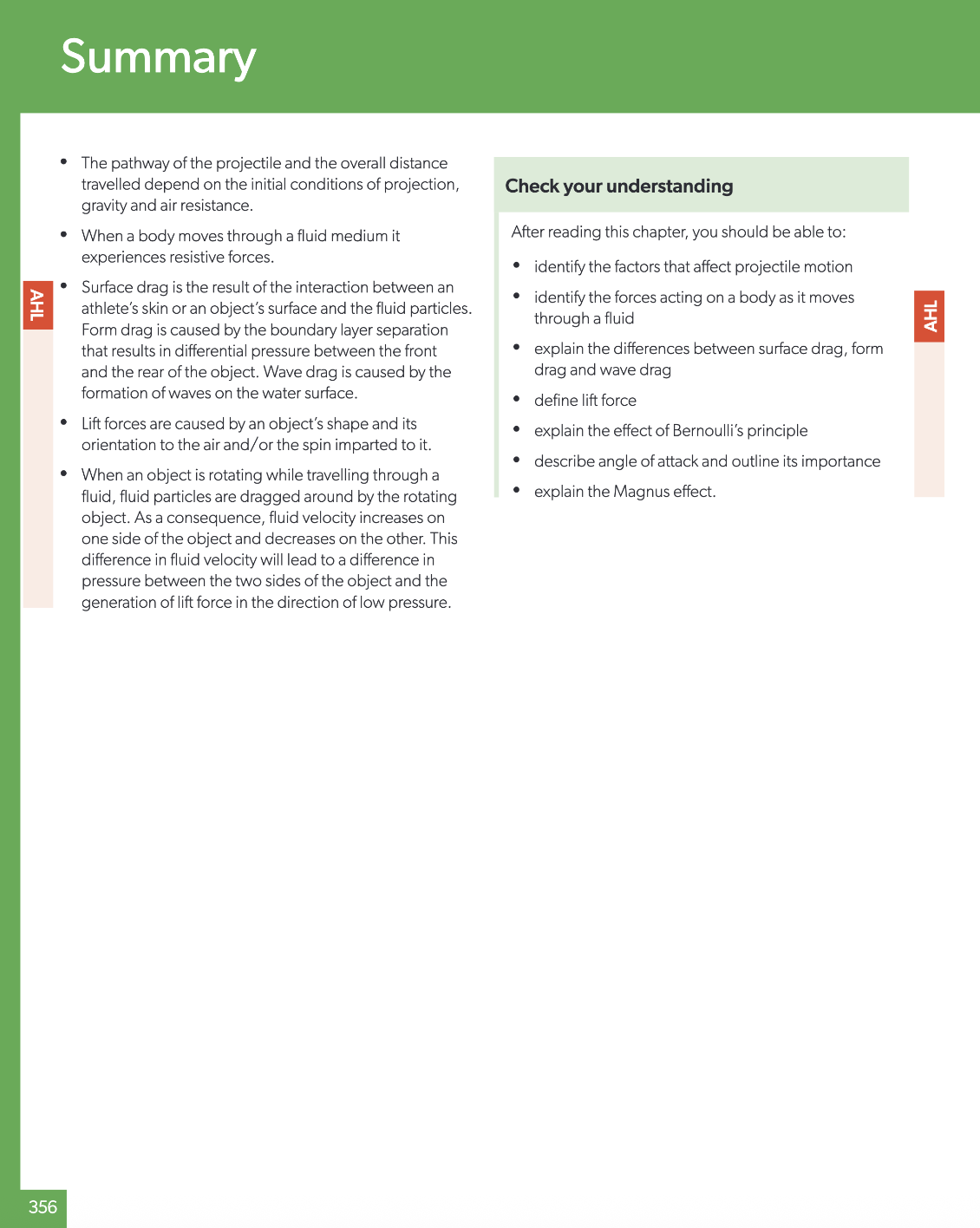
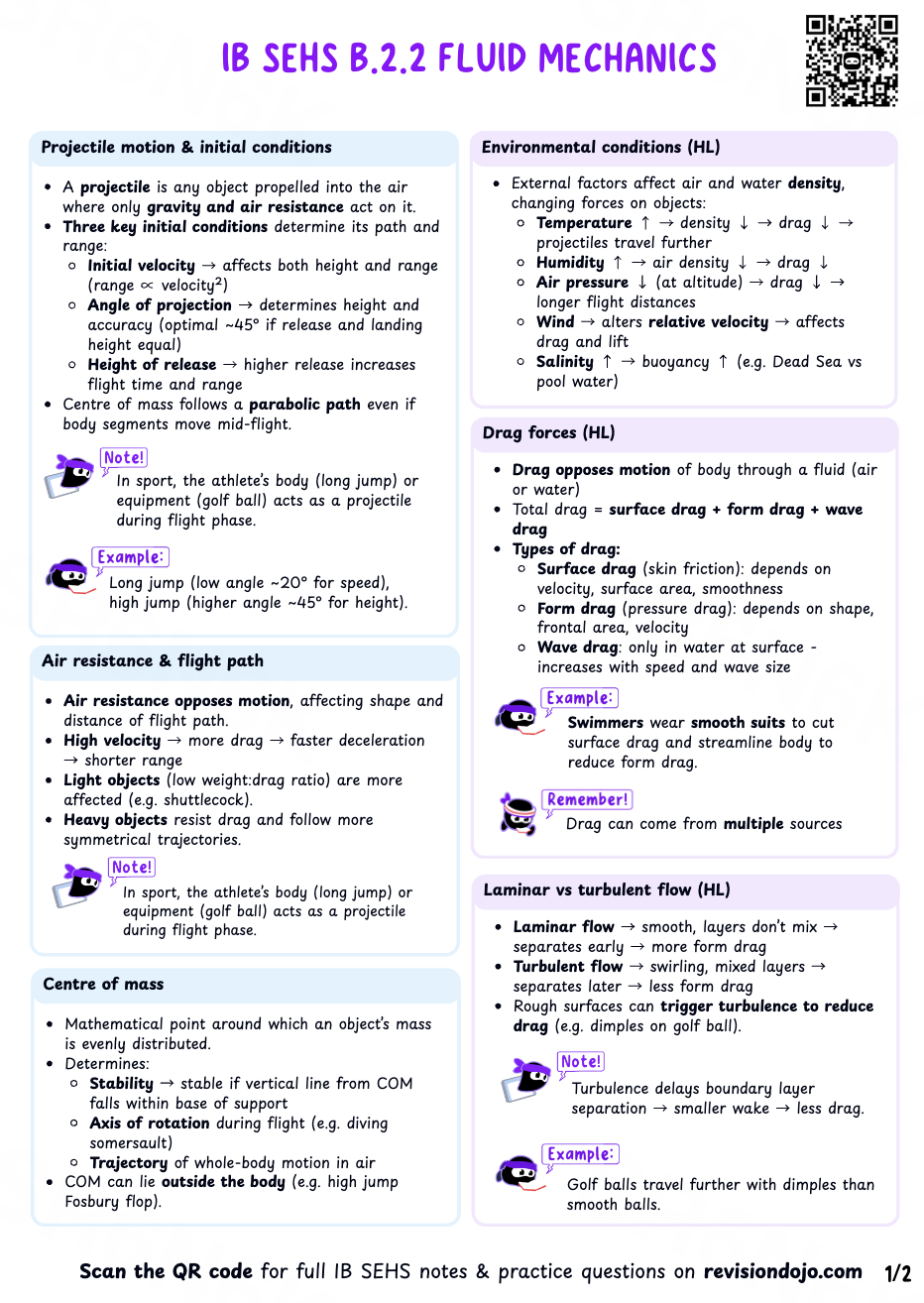
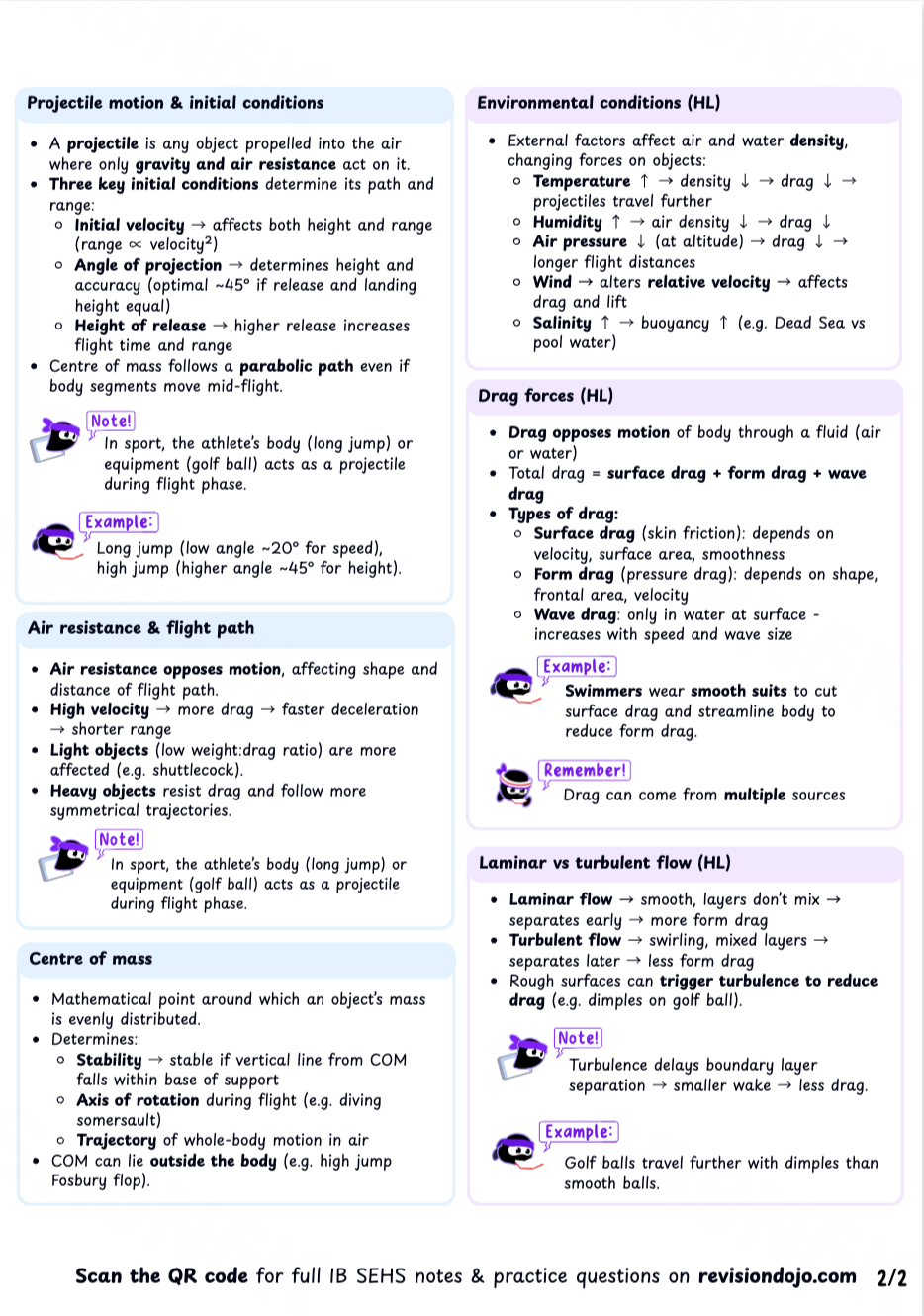
- Projectile motion refers to the movement of an object projected into the air, influenced only by gravity and air resistance p.334.
- The path of a projectile depends on its initial velocity, angle of projection, and height of release p.335.
- Drag is a resistive force composed of surface drag (friction) and form drag (pressure), which athletes try to minimize p.343-345.
- Bernoulli's principle states that the pressure exerted by a fluid is inversely related to its velocity, which is the mechanism for generating lift p.350.
- The Magnus effect describes how the spin of an object creates a pressure differential, causing the object's flight path to curve p.352.
To illustrate how the Magnus Effect works on a spinning ball:
- Spin: A player imparts topspin, backspin, or sidespin to a ball as it is kicked or struck.
- Fluid Velocity: The side of the ball spinning in the same direction as the oncoming air drags a layer of air with it, increasing the fluid velocity on that side. On the opposite side, the surface moves against the airflow, slowing the fluid velocity p.352.
- Pressure Differential: According to Bernoulli's principle, the area of higher fluid velocity experiences lower pressure, while the area of lower fluid velocity has higher pressure.
- Force Generation: This pressure difference creates a net force (the Magnus force) that pushes the ball from the high-pressure zone to the low-pressure zone, causing it to swerve or dip in flight p.352.
A competitive cyclist adopts a low, tucked position on their bike to reduce their frontal area. This minimizes form drag, which is the primary resistive force at high speeds. By making their body shape more streamlined, air flows more smoothly around them, reducing the low-pressure "wake" behind them and allowing them to travel faster for the same energy expenditure p.345, 354.
The theoretical optimal angle of projection to maximize range is 45°. However, in sports, this is rarely the case. For events like the shot put, where the release height is above the landing height, the optimal angle is lower (e.g., 35-42°) p.336-337.
B2.3 Movement Analysis and Its Applications
Movement analysis is a systematic approach to improving performance and preventing injury. By breaking down complex skills into distinct phases, coaches and athletes can observe and quantify movement, allowing them to identify biomechanical flaws and pinpoint specific areas for improvement.
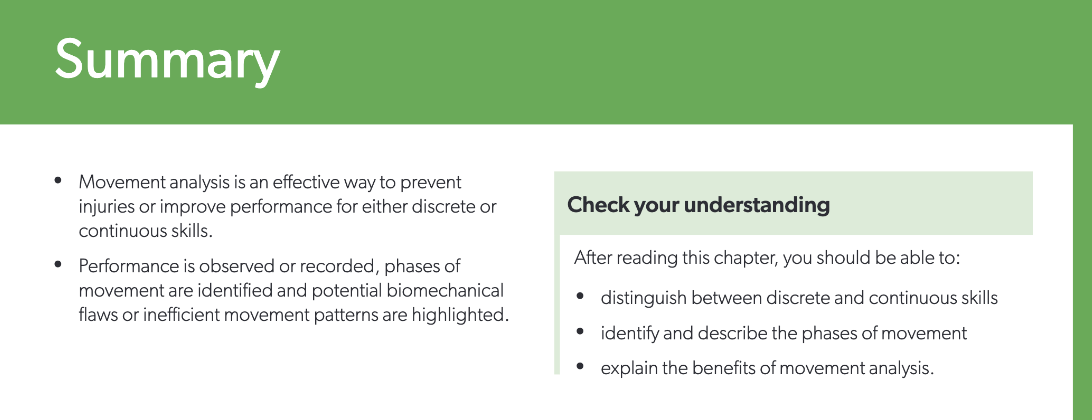
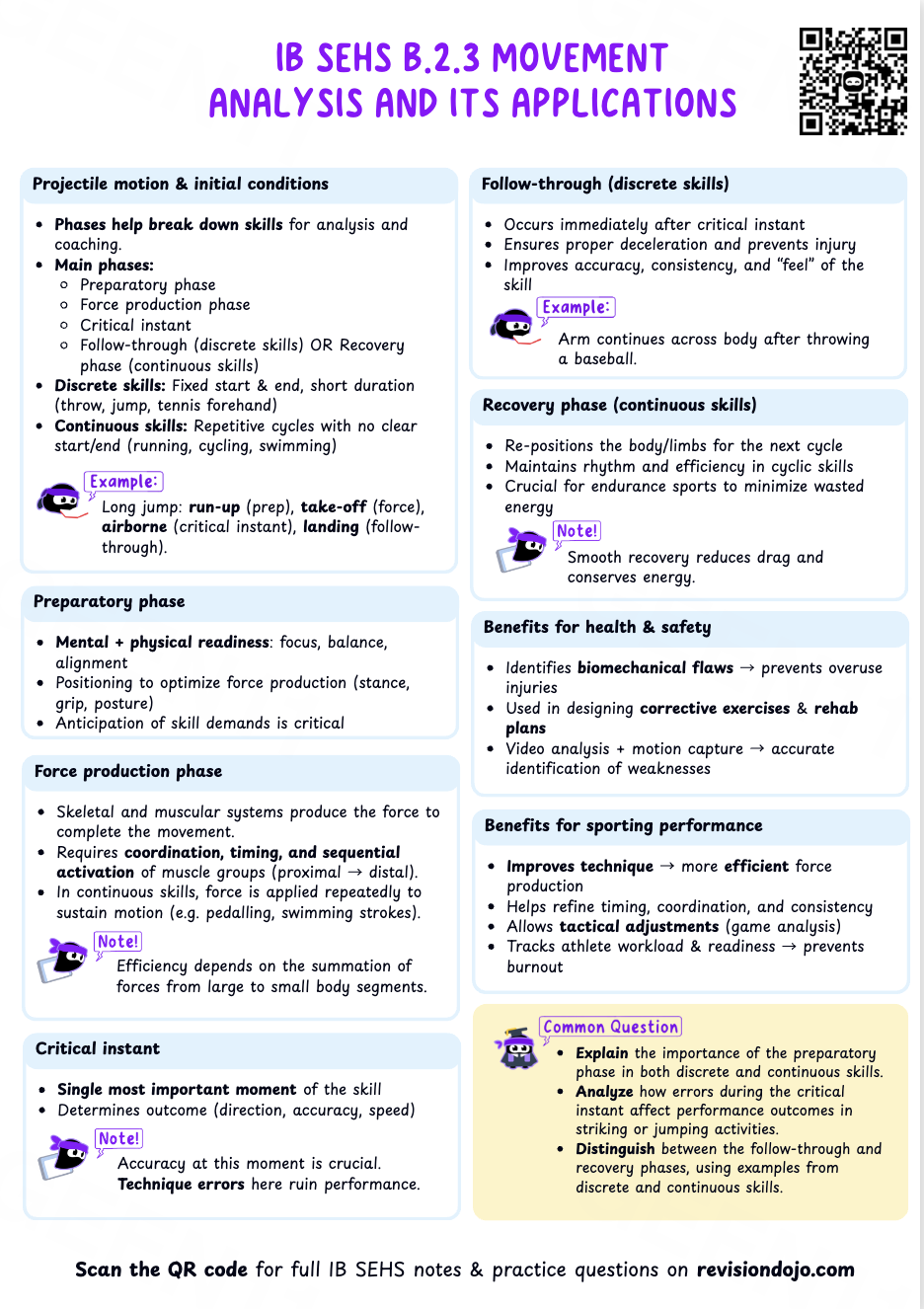
- The "phases of movement" approach breaks down skills into a preparatory phase, force production phase, critical instant, and follow-through p.359.
- Discrete skills have a clear beginning and end (e.g., throwing a ball), while continuous skills have no clear beginning or end (e.g., running or swimming) p.359, 361.
- Movement analysis can help identify inefficient movement patterns that may contribute to the risk of injury p.361.
To illustrate the phases of a discrete skill, consider the tennis forehand:
- Preparatory Phase: The player rotates their trunk and takes the racket back to prepare for the forward swing p.360, Image 1.
- Force Production Phase: The player initiates a synchronized movement of the hips, trunk, and arm to accelerate the racket towards the ball p.360, Images 2-3.
- Critical Instant: This is the moment of contact between the racket and the ball, which influences the shot's outcome p.360, Image 4.
- Follow-through: The racket continues to move across the body after impact, which helps to safely decelerate the arm and maintain balance p.360, Images 5-6.
Swimming is a continuous skill where the phases of movement are cyclical. For one arm stroke, the phases are Entry, Pull (when the hand moves backwards), Push (when the hand is aligned with the shoulder), and Recovery (when the hand exits the water). Analyzing these phases helps coaches identify issues like a poor "catch" during the pull phase, which can be corrected to improve propulsion p.361.
The follow-through phase occurs after the critical instant, so it does not influence the outcome of that specific skill execution (e.g., the ball has already left the racket). Its primary roles are to help prevent injury by allowing for gradual deceleration of the limbs and to prepare the body for the next movement p.360.
Having deconstructed the core theory, the next step is to apply this knowledge to exam-style practice questions.
Applying your knowledge through practice is the key to exam success. This section provides a range of questions mirroring the style of Paper 1A, Paper 1B, and Paper 2 to test your comprehension and analytical skills across Topic B2.
Why A is wrong: This describes Newton's second law of motion (F=ma) p.315.
Why B is wrong: This describes Newton's first law of motion (the law of inertia) p.315.
Why D is wrong: This describes the principle of conservation of angular momentum, not one of Newton's three primary laws of motion p.322.
Why A is wrong: 45° is the optimal angle only when the projection height and landing height are the same p.336.
Why B is wrong: An angle greater than 45° is optimal when the projection height is below the landing area, such as in a basketball free throw p.336.
Why D is wrong: While initial velocity is a critical factor affecting projectile range, the angle of projection is also highly significant p.335.
Why A is wrong: Surface drag is caused by friction between the fluid and the object's surface. While it is a factor, streamlining is primarily aimed at reducing form drag, which is more significant at higher speeds p.343. Swimmers reduce surface drag by shaving skin or wearing smooth suits p.344.
Why B is wrong: Wave drag is caused by making waves at the interface between two fluids (like water and air) and is primarily relevant to sports like swimming and rowing, not cycling p.347.
Why D is wrong: The Magnus force is a lift force generated by a spinning object and is not a type of drag p.352.
Why A is wrong: The preparatory phase involves the movements that get the athlete ready for the main action p.359.
Why B is wrong: The force production phase involves the synchronized movements that generate force to be applied to an object p.359.
Why D is wrong: The follow-through occurs immediately after the critical instant and is important for injury prevention and balance p.360.
The questions below provide insight into the types of challenges you will face in Paper 1B. Unlike standard knowledge checks, this component places a distinct emphasis on data analysis and experimental work.
Success in Paper 1B requires you to apply the "Nature of Science" (NOS) skills—such as evaluating methodologies, interpreting graphs, and understanding study design—rather than simply recalling course content.
To access a complete archive of true past papers and exemplar materials for Paper 1B, please use the resource link below.
| Displacement / m | 10 | 20 | 30 | 40 | 50 | 60 | 70 | 80 | 90 | 100 |
|---|---|---|---|---|---|---|---|---|---|---|
| Time / s | 1.89 | 2.88 | 3.78 | 4.64 | 5.47 | 6.29 | 7.10 | 7.92 | 8.75 | 9.58 |
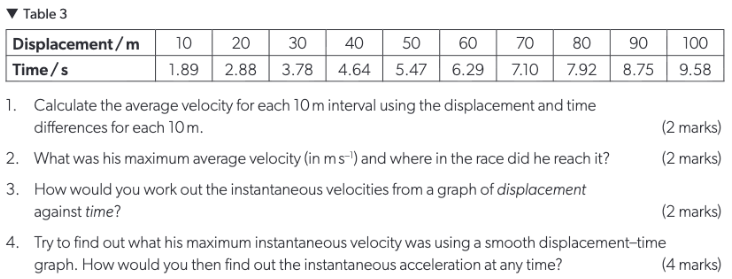
Calculate the average velocity for each 10m interval using the displacement and time differences for each 10 m. [2 marks]
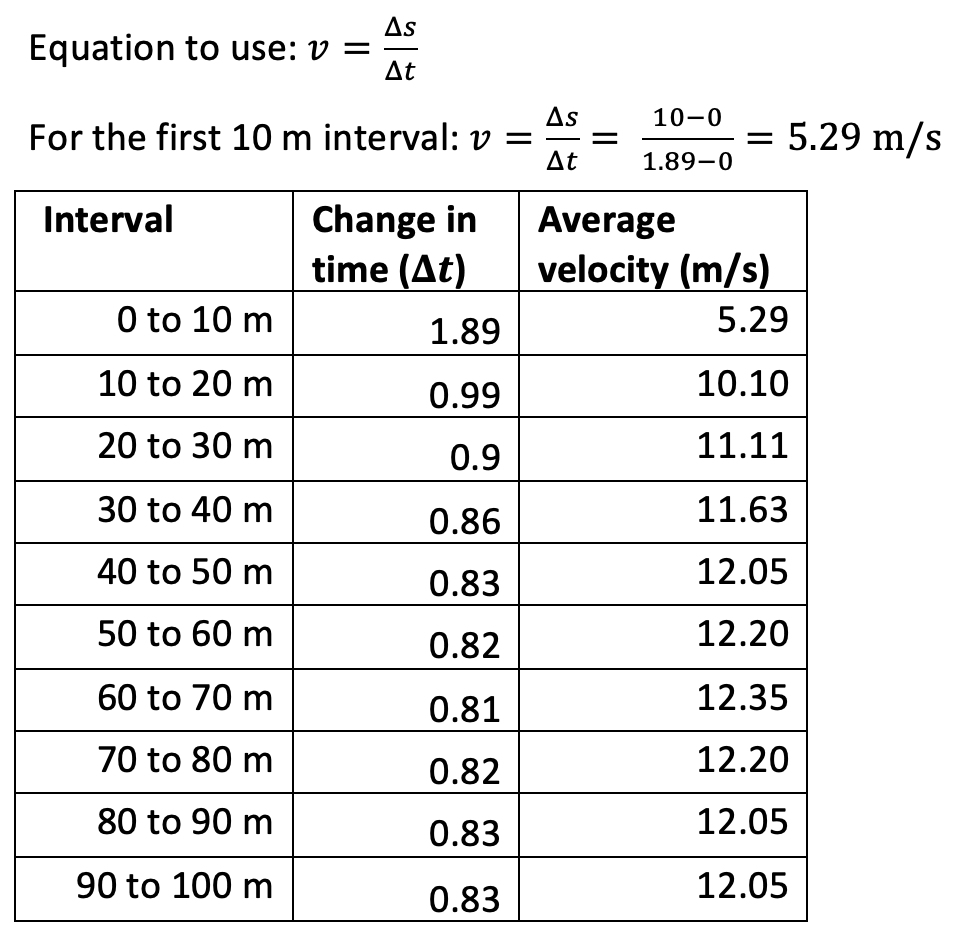
What was his maximum average velocity (in m/s) and where in the race did he reach it? [2 marks]
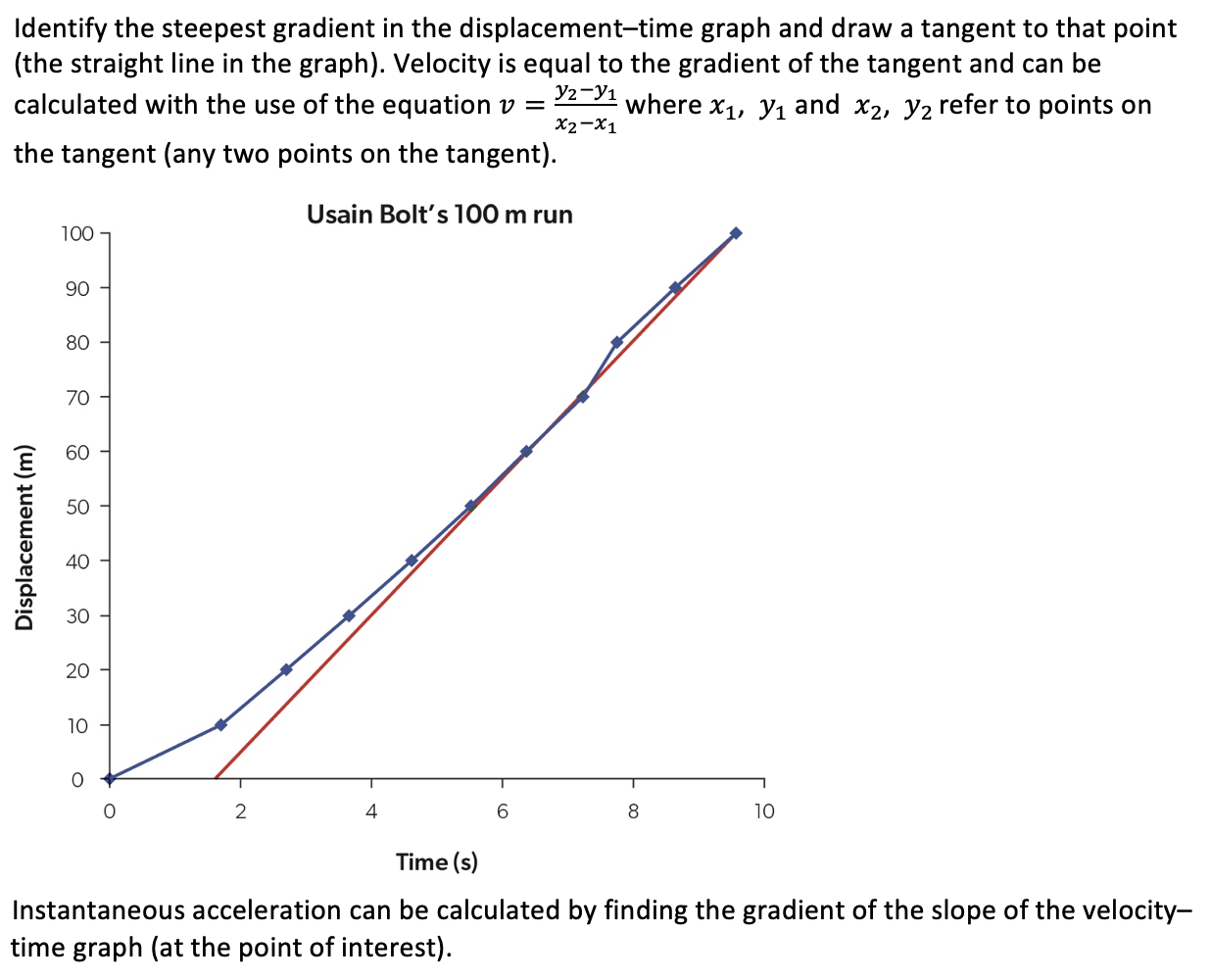
How would you work out the instantaneous velocities from a graph of displacement against time? [2 marks]
Try to find out what his maximum instantaneous velocity was using a smooth displacement-time graph. How would you then find out the instantaneous acceleration at any time? [4 marks]
Identify which trial had the lowest mean oxygen uptake at the 4 km mark. [1 mark]
Calculate the difference in mean oxygen uptake at the 1 km mark between the trial with drafting (5RunD) and the trial without drafting (5RunND). [2 marks]
Using the data, explain the effect of drafting during the cycling stage on the subsequent running performance. [3 marks]
| Movement | Guard | Forward | Centre |
|---|---|---|---|
| Frequency | |||
| sprint | 67 | 56 | 43 |
| jump | 41 | 41 | 49 |
| stand | 141 | 149 | 150 |
| Average time (s) | |||
| sprint | 1.9 | 2.1 | 2.2 |
| jump | 0.9 | 1.0 | 1.1 |
| stand | 2.2 | 2.2 | 2.4 |
Identify which position performed the most jumps. [1 mark]
Calculate the total time spent sprinting by a Guard during the recorded period. [2 marks]
Discuss, using data from the table, which position is the most physically demanding. [3 marks]
| Athlete | Take-off (L₁) / m | Flight (L₂) / m | Landing (L₃) / m | Total Distance / m |
|---|---|---|---|---|
| 1 | 0.46 | 7.77 | 0.56 | 8.79 |
| 2 | 0.53 | 7.80 | 0.22 | 8.39 |
| 3 | 0.47 | 7.80 | 0.12 | 8.35 |
| 4 | 0.25 | 7.45 | 0.36 | 8.06 |
Identify which jump had the longest flight distance (L₂). [1 mark]
Evaluate the technique of the landing phase for Athlete 3 compared to Athlete 1. [2 marks]
A researcher stated that this data collection method is valid for comparing performance. Suggest one limitation of using only these distance measurements to evaluate the overall technique of a long jumper. [2 marks]
Proficiency in SEHS requires you to be more than a theorist; you must be a quantitative problem-solver. Biomechanical principles are often expressed through equations, and demonstrating your ability to apply them is critical for success in Paper 1B and Paper 2. This section provides a worked example to sharpen these essential skills.
Power is the rate at which work is done, or the product of force and velocity. It is a key component of athletic performance. The formula is: P = Fv p.330
Variables:
- P = Power (measured in Watts, W)
- F = Force (measured in Newtons, N)
- v = velocity (measured in metres per second, m s⁻¹)
Worked Example: A cyclist is riding at a constant velocity of 12 m s⁻¹. The total resistive force from air resistance and friction is 40 N. Calculate the power output of the cyclist.
Step 1: Identify the known variables.
- Force (F) = 40 N
- velocity (v) = 12 m s⁻¹
Step 2: State the formula.
- P = Fv
Step 3: Substitute the values into the formula.
- P = 40 N × 12 m s⁻¹
Step 4: Calculate the result and include units.
- P = 480 W
Conclusion
Answer: The power output of the cyclist is 480 Watts.
Practicing these types of calculations is vital for demonstrating your understanding in both Paper 1B and Paper 2.
Even with a strong understanding of the material, students can fall into common traps and misunderstandings related to the concepts in Topic B2. Being aware of these potential pitfalls is a key step toward avoiding them in an exam and ensuring your answers are precise and accurate.
During your revision, pay special attention to these concepts and double-check that your understanding is clear and correct.
The IB SEHS curriculum is designed to be integrated, meaning concepts from one topic often connect to and reinforce others. Being able to make these connections demonstrates a deeper level of understanding. This section poses questions that link the concepts of forces and motion to other areas of the course to encourage holistic thinking.
- Consider resistance training in water or on sand, which increases friction and drag to build muscular strength and endurance.
- Think about speed and agility training using resistance bands or parachutes, which apply a drag force the athlete must overcome.
- Consider how this type of training aids in technique development and injury prevention.
- Think about the benefit of low-impact exercises in a swimming pool, where drag provides resistance while buoyancy reduces stress on joints.
- Law of inertia: Coaches can advise on body positioning and stability to conserve energy and overcome an opponent's inertia.
- Law of acceleration: Coaches can focus on enhancing power-to-weight ratio to maximize acceleration.
- Law of action-reaction: Coaches can instruct athletes on how to apply forces against the ground (e.g., in running or jumping) or an object (e.g., in throwing) to generate powerful propulsive reaction forces.
- Impulse and momentum: Coaches can focus on techniques that increase the time over which a force is applied (e.g., longer strides in running) to generate greater momentum.
As you study, actively look for these kinds of connections across all topics to build a more robust and flexible knowledge base.
Use this checklist as a final audit of your knowledge. Be honest in your self-assessment to pinpoint any remaining gaps in your understanding before the exam.
- Can I outline Newton's three laws of motion and provide a sporting example for each? p.332
- Can I distinguish between key kinematic pairs: vector/scalar, distance/displacement, and speed/velocity? p.310
- Can I explain the principle of conservation of angular momentum and how athletes manipulate their moment of inertia to change their rate of rotation? p.322
- Can I distinguish between the coefficient of static friction and dynamic friction? p.332
- Can I identify and describe the factors that influence the path of a projectile in sport? p.356
- Can I explain the differences between surface drag, form drag, and wave drag? p.356
- Can I explain the effect of Bernoulli's principle and the Magnus effect on objects in flight? p.356
- Can I distinguish between discrete and continuous skills and identify the phases of movement for each? p.363
🎉 Topic B2 - Forces, Motion and Movement Mastered!
You've completed your study of biomechanics. With this foundational knowledge, you're ready to analyze movement with precision and tackle any exam question with confidence!