Topic C1 - Individual Differences
A comprehensive study guide covering personality and mental toughness in IB SEHS 2026.
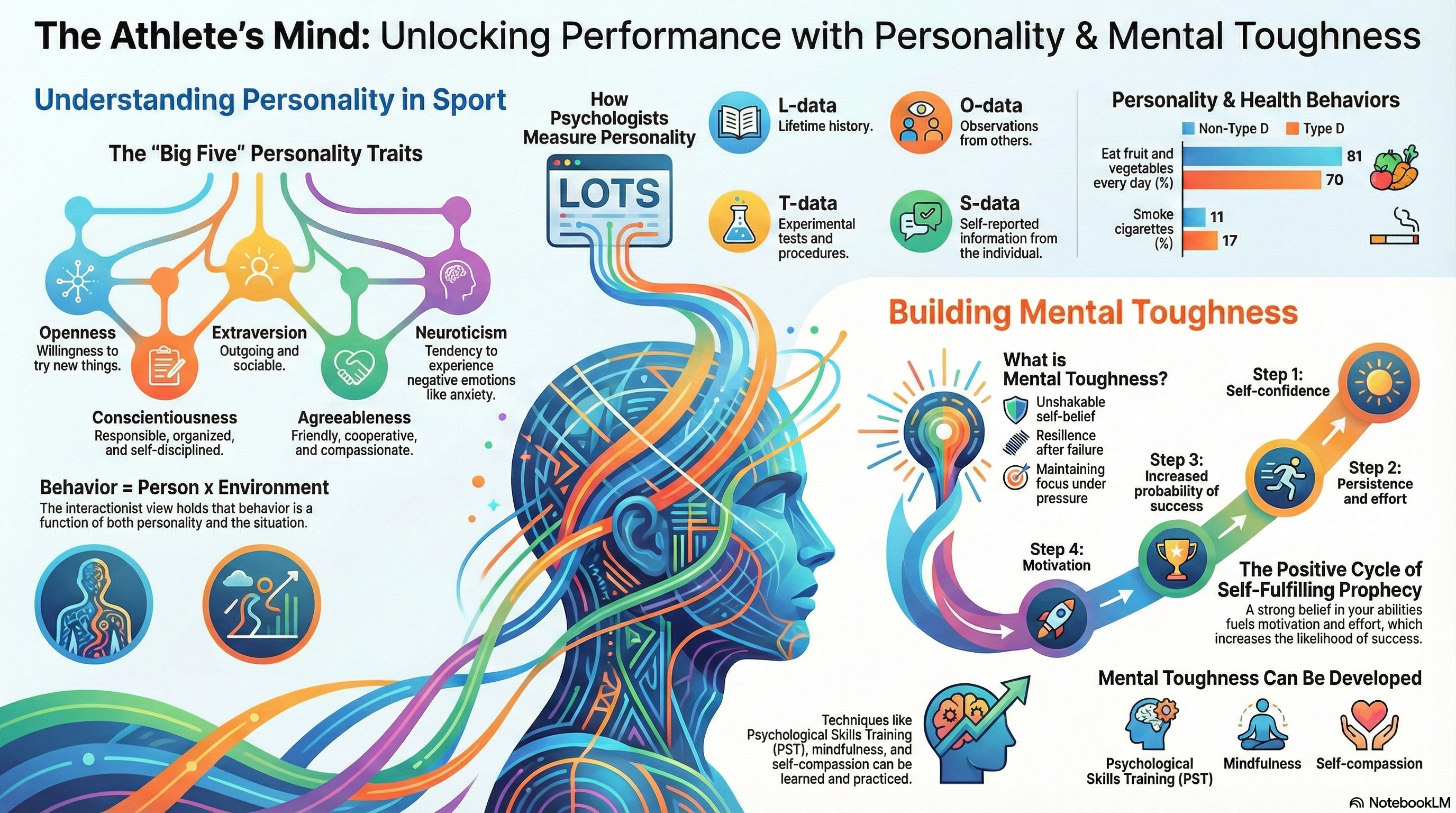
Understanding the psychological makeup of an athlete is critical for maximizing performance. Topic C.1 explores the unique characteristics that distinguish one athlete from another, focusing on personality and mental resilience. Mastering these definitions is the first step toward analyzing why different athletes respond differently to the same competitive pressures.
These terms form the vocabulary you will use to deconstruct athlete behavior in your exam responses.
Next, we look at the specific command terms used to test your understanding of these psychological concepts.
In Psychology of Sport, precise language is key. The IB uses specific command terms to direct your answers. Confusing "Describe" with "Discuss" can cost you valuable marks. Below are model questions and answers demonstrating exactly what is expected for Topic C.1.
| Command Term | C.1 Model Question & Answer |
|---|---|
| State | Q: State the five personality traits in the Big Five
model. A: The five traits are Openness, Conscientiousness, Extraversion, Agreeableness, and Neuroticism (often remembered by the acronym OCEAN). |
| Outline | Q: Outline the interactionist approach to
personality. A: The interactionist approach proposes that behavior is determined by the interaction between a person's underlying personality traits and the specific situation or environment they are in. It suggests that traits alone cannot predict behavior; instead, behavior (B) is a function (f) of the person (P) and the environment (E), written as B = f(P,E). |
| Describe | Q: Describe the 'Commitment' component of the 4Cs model of
mental
toughness. A: Commitment refers to "stickability"—the ability to set goals and strive to achieve them despite obstacles. A mentally tough athlete with high commitment is reliable, disciplined, and persists in their efforts even when motivation levels drop or difficulties arise. |
| Explain | Q: Explain how high levels of Neuroticism might affect an
athlete's
performance in a high-pressure final. A: Neuroticism is characterized by emotional instability, anxiety, and moodiness. An athlete with high levels of neuroticism is more likely to interpret a high-pressure final as a threat rather than a challenge. This can lead to excessive somatic anxiety (physical tension) and cognitive anxiety (worry), which may overwhelm their ability to process information and execute skills, ultimately leading to a decrease in performance. |
| Discuss | Q: Discuss the issues associated with the measurement of
personality in sport. A: Personality is typically measured using questionnaires (e.g., Eysenck Personality Inventory, Cattell 16PF), but there are several issues. Firstly, accuracy depends on the athlete's honesty; they may fake answers to look "better" (social desirability bias). Secondly, the questions can be ambiguous and interpreted differently by different people. Thirdly, these tests often measure traits (stable) but do not account for the state (situation), meaning they may not successfully predict actual behavior in a specific sporting context. |
With these command terms clarified, let's explore the core content in detail.
This section breaks down the two main pillars of Topic C.1: Personality and Mental Toughness. Understanding these concepts allows us to appreciate why athletes behave differently and how psychological resilience can be developed.
C.1.1 Personality
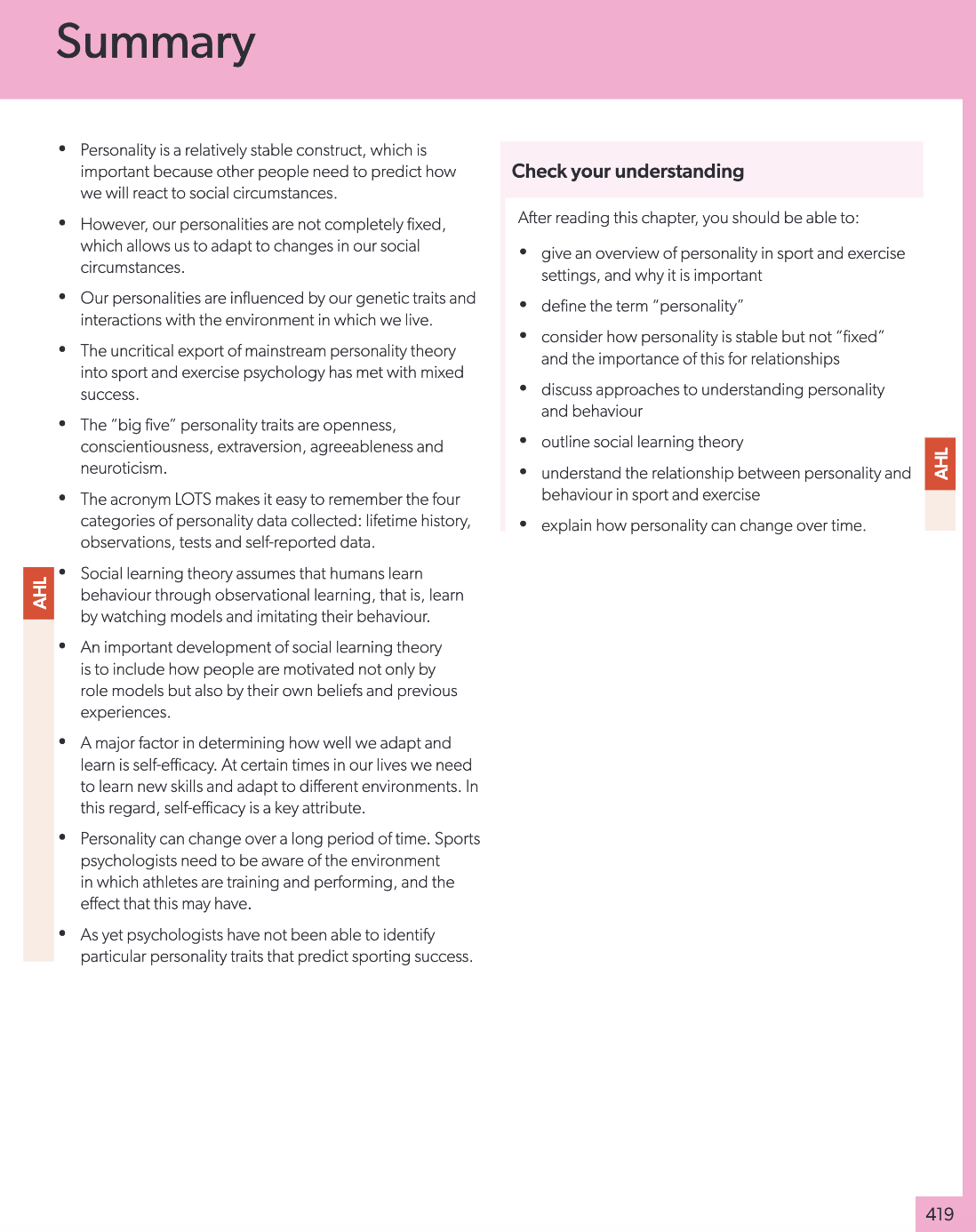
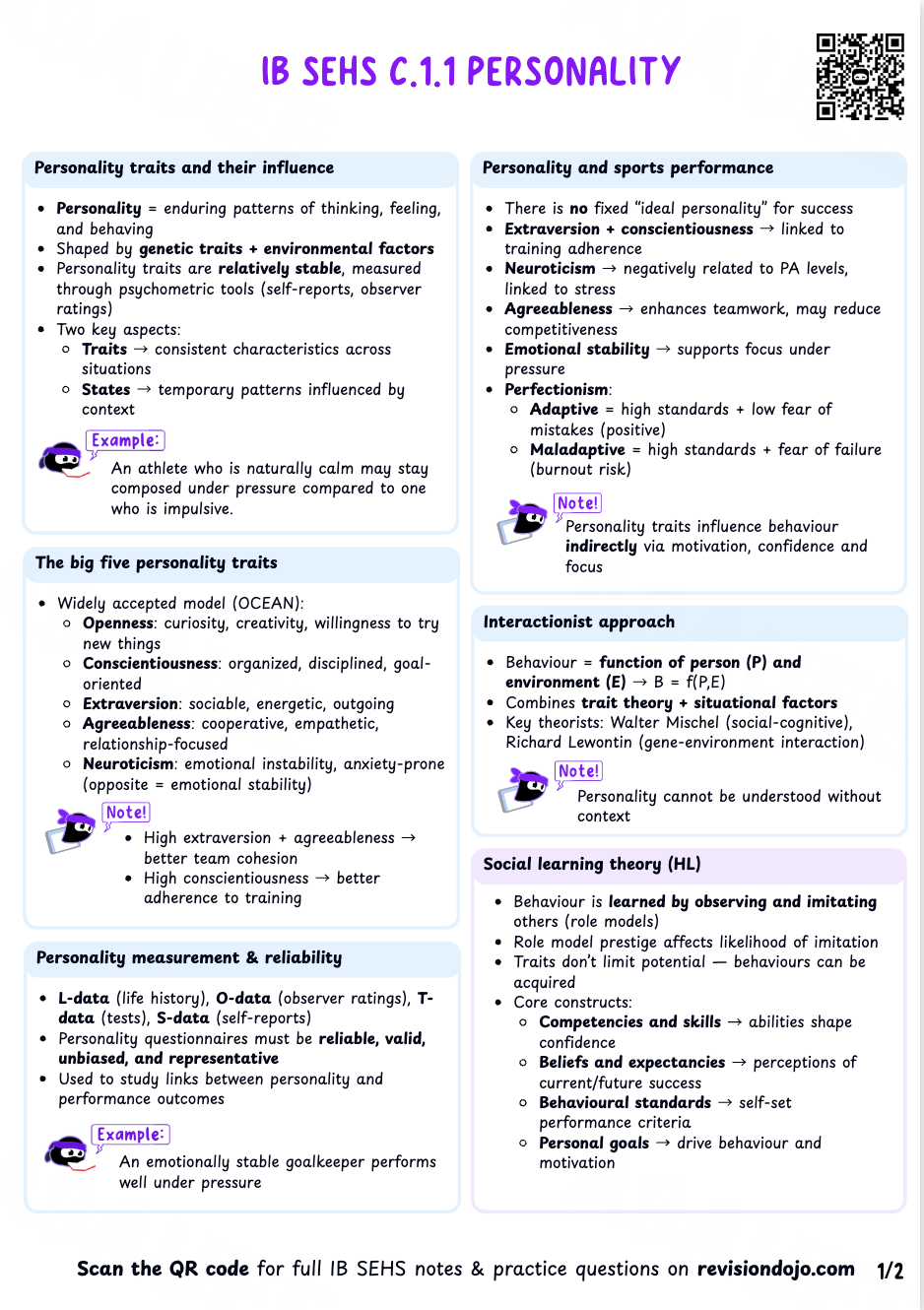
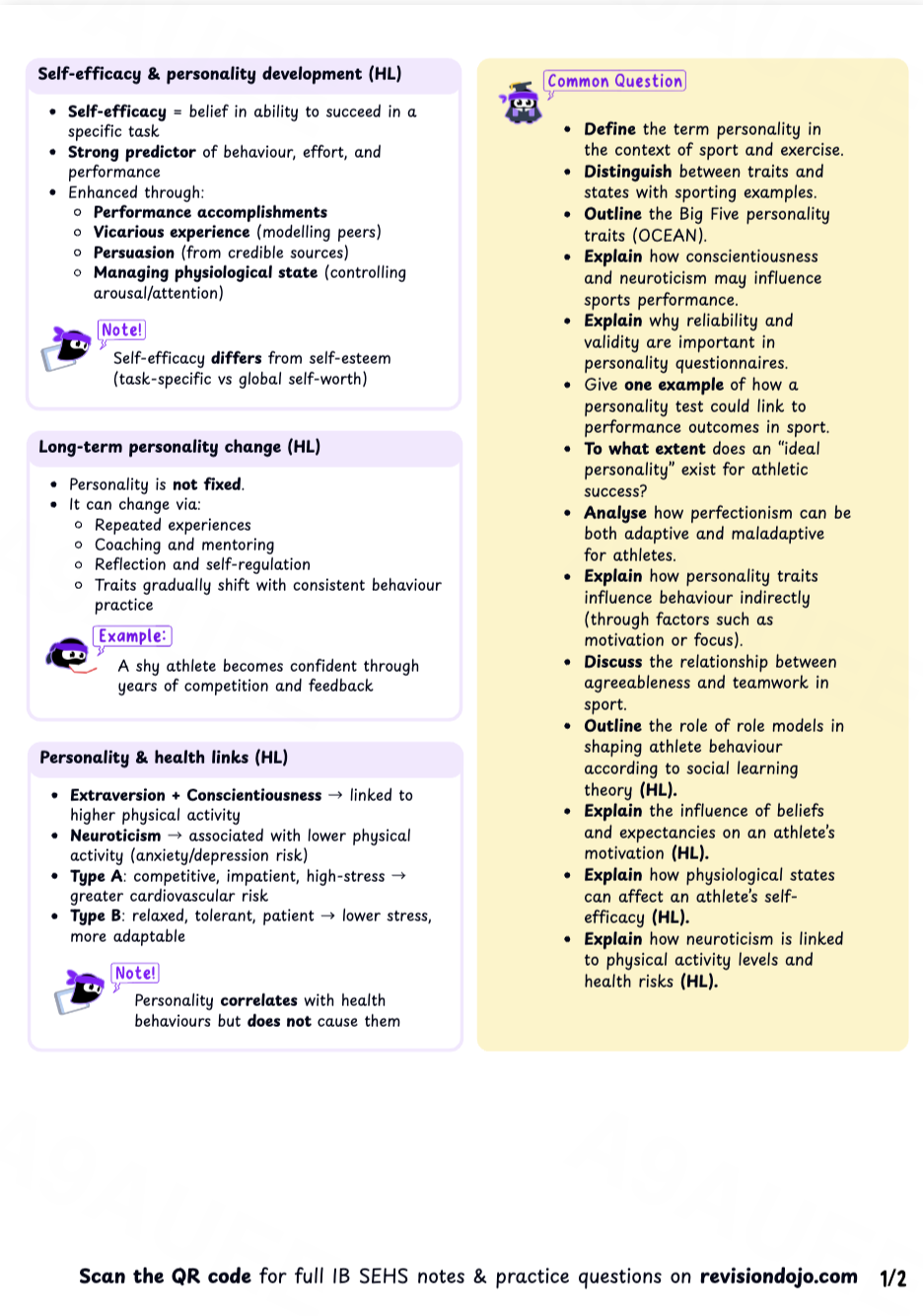
Personality refers to the stable, enduring characteristics that make an individual unique. In sport, understanding personality helps coaches tailor their approach to motivation, feedback, and team dynamics.
- Trait Theory: Suggests personality is innate and stable. Traits (e.g., aggression, introversion) predispose an athlete to act in a certain way. However, this theory is criticized for ignoring the impact of the situation.
- The Big Five (OCEAN): A modern framework for personality
traits:
- Openness: Curiosity, willingness to try new training methods.
- Conscientiousness: Discipline, organization, goal-directed behavior.
- Extraversion: Sociability, energy, assertiveness (often linked to team sports).
- Agreeableness: Cooperativeness, trust, helpfulness.
- Neuroticism: Emotional instability, anxiety, moodiness.
- Interactionist Approach: The most widely accepted view in sport psychology. It states that behavior is a mix of personality traits and environmental factors. For example, a normally calm athlete (trait) might become aggressive (behavior) in a high-stakes derby match (environment).
Research suggests that extroverts, who have lower levels of natural arousal, may seek out high-stimulation sports (e.g., rugby, boxing) to reach their optimal arousal level. Conversely, introverts, who have higher baseline arousal, may prefer low-stimulation, precision sports (e.g., archery, shooting) to avoid over-arousal.
C.1.2 Mental Toughness
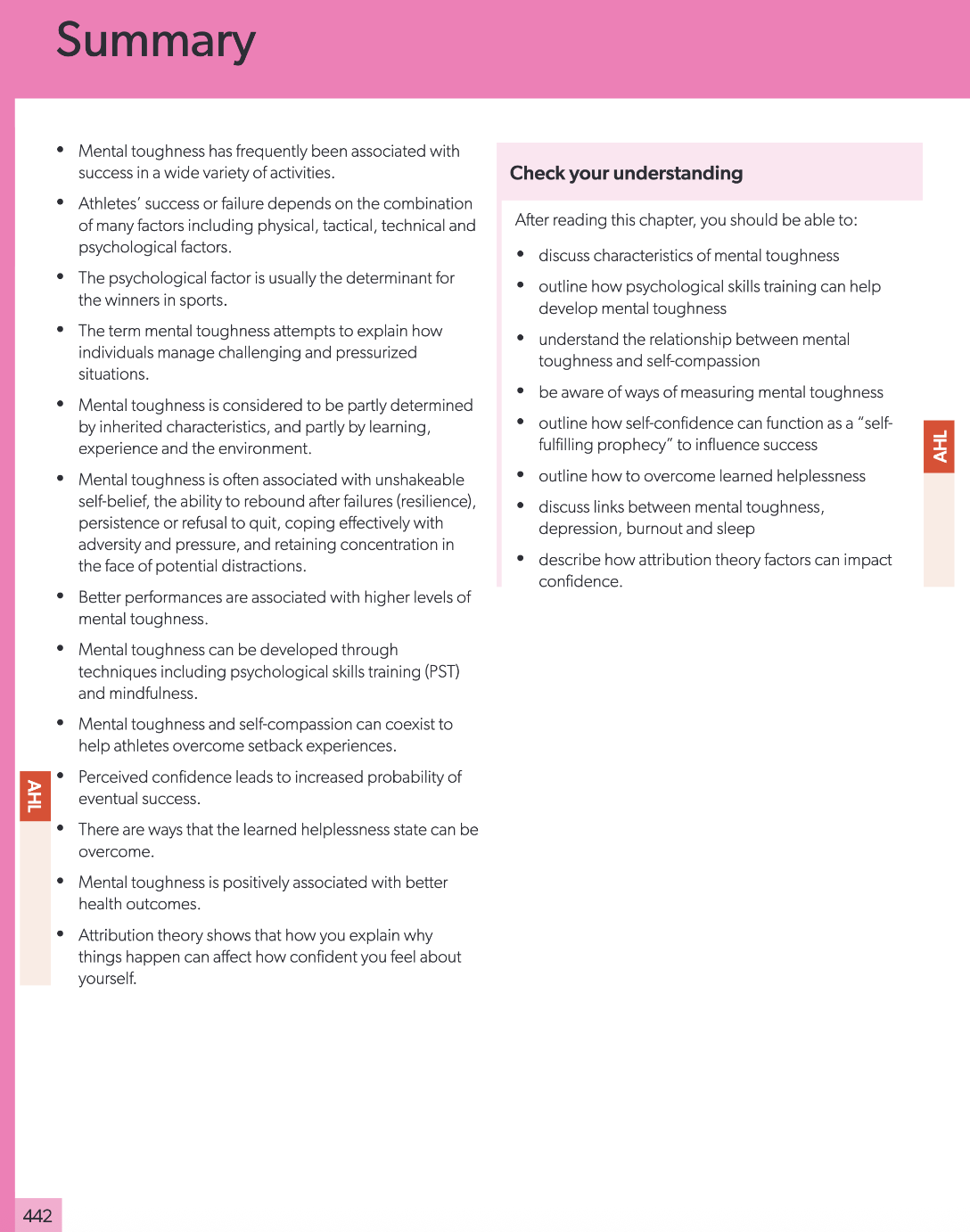
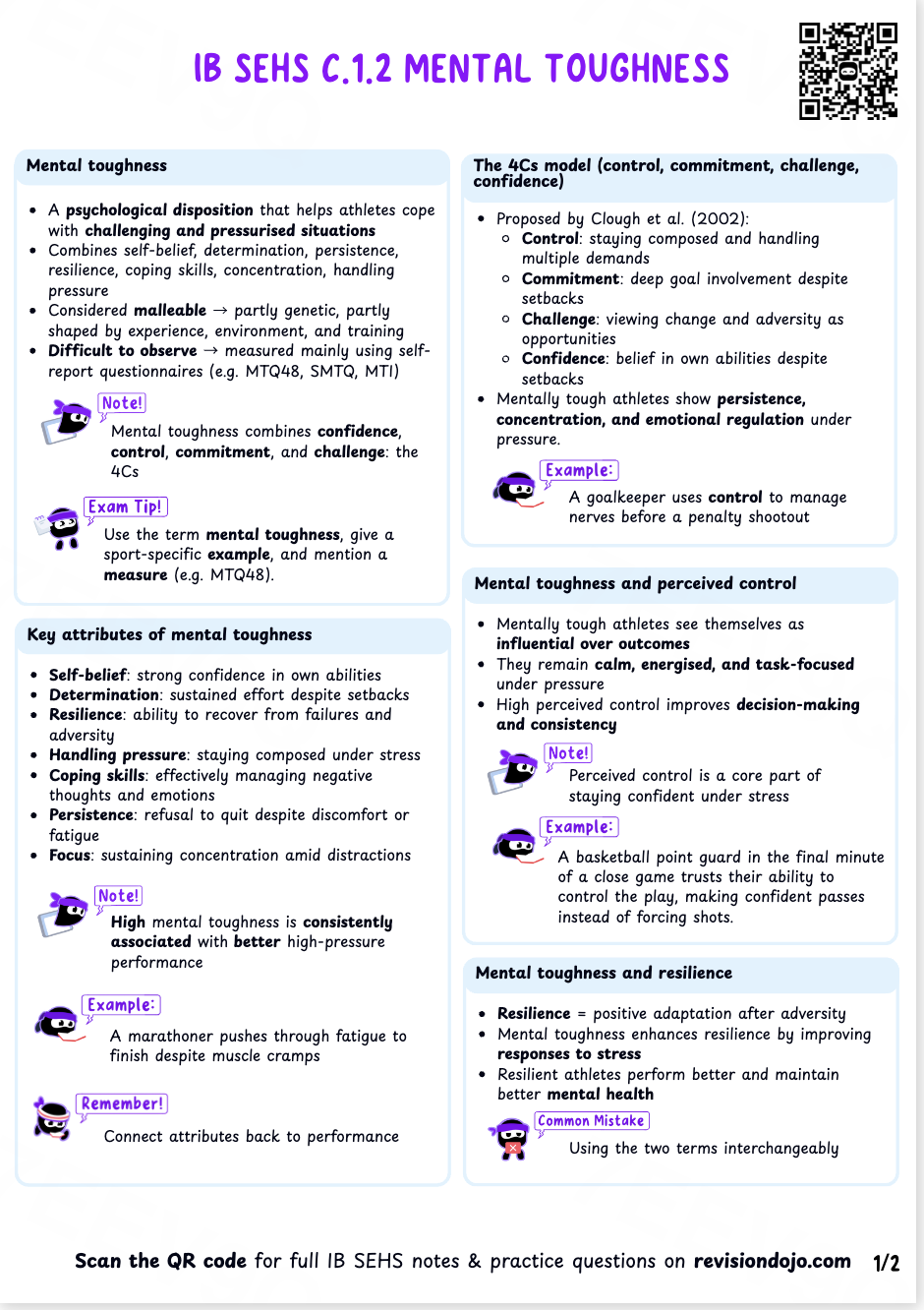
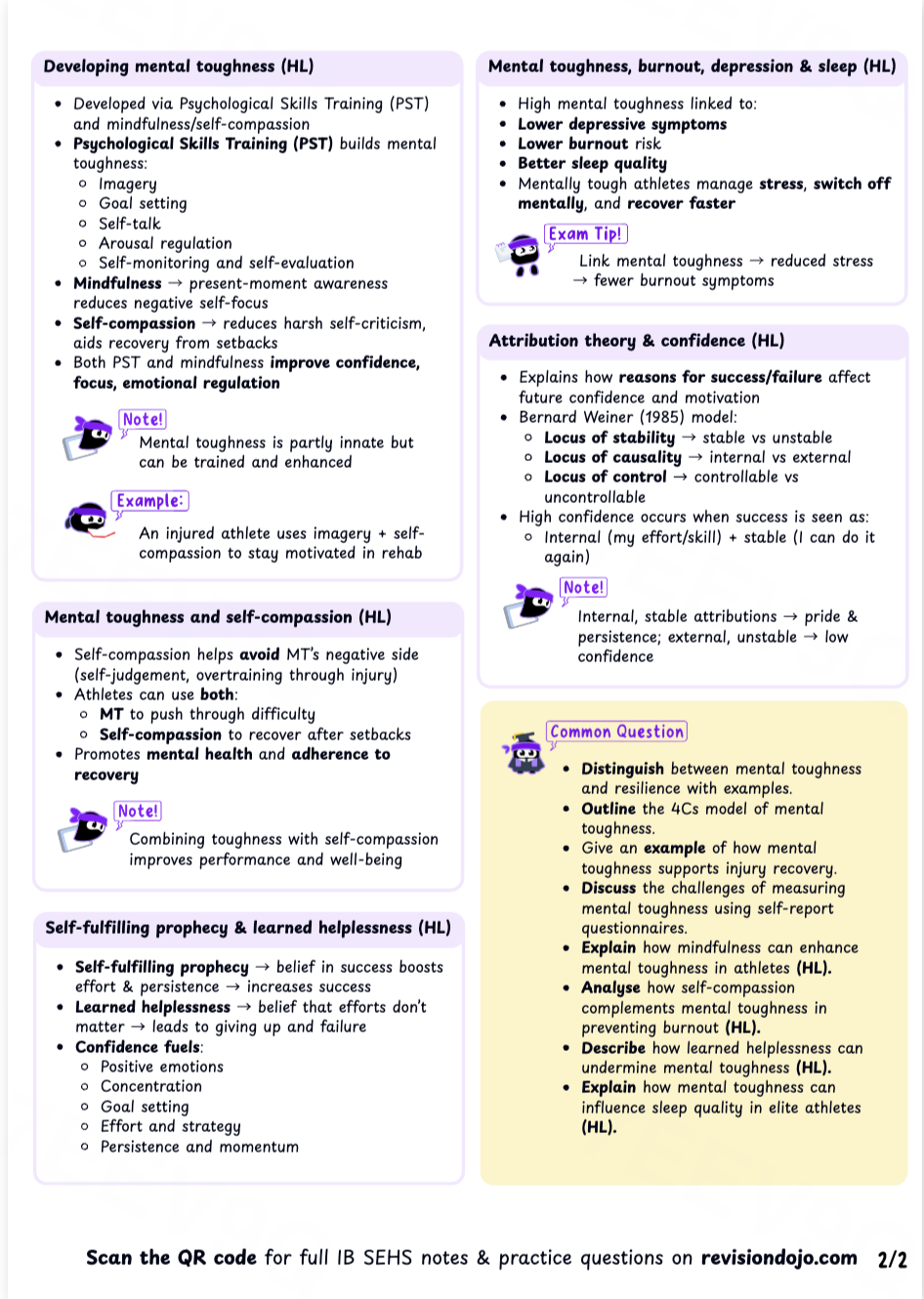
Mental toughness is the psychological edge that allows athletes to cope better than their opponents with the demands of competition, training, and lifestyle. It is crucial for consistency and resilience.
- Mental toughness is defined as the ability to rebound from failure, cope with pressure, and persist in the face of adversity.
- The 4Cs Model (Clough et al.):
- Control: Emotional control (keeping emotions in check) and Life control (believing you can shape your own destiny).
- Commitment: Setting goals and sticking to them; reliability and discipline.
- Challenge: Viewing threats as opportunities for growth; embracing change and risk.
- Confidence: Belief in one's abilities (Self-efficacy) and Interpersonal confidence (assertiveness in social groups).
While mental toughness helps athletes cope with stress, it is not the same as mental health. A mentally tough athlete can still experience mental health issues. Coaches must be careful not to assume that "tough" athletes don't need emotional support.
Now, let's test your understanding with some practice questions.
Apply your knowledge of personality and mental toughness to these exam-style questions.
Why A is wrong: This represents Trait Theory (behavior is determined only by personality).
Why B is wrong: This represents Social Learning Theory (behavior is determined only by the environment).
Why A is wrong: Control relates to emotional regulation and life influence.
Why B is wrong: Commitment relates to goal-setting and persistence.
Why C is wrong: Extraversion reflects sociability and energy.
Why A is wrong: Openness reflects curiosity and creativity.
The questions below provide insight into the types of challenges you will face in Paper 1B. Unlike standard knowledge checks, this component places a distinct emphasis on data analysis and experimental work.
Success in Paper 1B requires you to apply the "Nature of Science" (NOS) skills—such as evaluating methodologies, interpreting graphs, and understanding study design—rather than simply recalling course content.
To access a complete archive of true past papers and exemplar materials for Paper 1B, please use the resource link below.
| Group | Extraversion (Mean score) | Neuroticism (Mean score) |
|---|---|---|
| Team Sport Athletes (e.g., Rugby, Soccer) | 16.5 | 8.2 |
| Individual Sport Athletes (e.g., Tennis, Archery) | 10.4 | 7.9 |
Identify the group with the highest mean Extraversion score. [1 mark]
Calculate the difference in Neuroticism scores between the two groups. [1 mark]
Using the data and your knowledge of personality, suggest one reason for the difference in Extraversion scores. [2 marks]
Control refers to an athlete's ability to regulate their emotions and believe they have influence over their life. In a tournament, this prevents an athlete from becoming overwhelmed by anxiety or anger after a bad referee call. [1 mark]
Commitment involves goal-setting and "stickability." It ensures the athlete remains disciplined in their preparation and focused on the end goal, even when fatigued during the later stages of competition. [1 mark]
Challenge is the mindset of viewing stressful situations as opportunities for growth rather than threats. This allows an athlete to embrace the pressure of a final as a chance to shine, rather than fearing failure. [1 mark]
Confidence is the belief in one's abilities (self-efficacy). High confidence allows an athlete to trust their skills under pressure and maintain belief even after making a mistake. [1 mark]
Overall, these components allow a mentally tough athlete to remain consistent, resilient, and perform at their peak despite the high demands of a major tournament. [1 mark]
In sport psychology, data often comes from questionnaires and surveys (e.g., Likert scales). A key skill is interpreting this data, particularly understanding the Standard Deviation.
Interpreting Standard Deviation in Personality Tests
Standard Deviation (SD) measures how spread out the scores are from the mean (average).
- Low SD: Data points are close to the mean. This suggests the group is homogeneous (very similar personality traits).
- High SD: Data points are spread out. This suggests the group is heterogeneous (very different personality traits).
Team A Anxiety Score: Mean = 15, SD = 1.2
Team B Anxiety Score: Mean = 15, SD = 5.8
Interpretation: Even though both teams have the same average anxiety, Team A is very consistent (everyone is moderately anxious). Team B is very mixed (some very calm, some highly anxious). A coach would need different strategies for Team B (individualized) compared to Team A (group approach).
Avoid these common pitfalls in your exam answers.
Demonstrate holistic understanding by connecting C.1 to other topics.
- Athletes with high "Need for Achievement" (personality trait) are likely to be intrinsically motivated and seek challenging tasks.
- Athletes with high "Need to Avoid Failure" may require more external validation and lower-risk goals to maintain motivation.
- Extroverts may be more motivated by public recognition (extrinsic), while introverts may be driven by personal improvement (intrinsic).
- Mentally tough athletes (high Commitment) are more likely to adhere strictly to rehabilitation protocols.
- They are more likely to view the injury as a "Challenge" to overcome rather than a disaster, maintaining a positive mindset.
- However, high "Control" and "Challenge" might lead them to return too early, ignoring pain signals.
Review these points to ensure you are exam-ready.
- Can I define personality and mental toughness?
- Can I list and explain the Big Five personality traits (OCEAN)?
- Can I explain the Interactionist Approach and write the formula B = f(P, E)?
- Can I outline the 4Cs of Mental Toughness (Control, Commitment, Challenge, Confidence)?
- Can I discuss the limitations of using questionnaires to measure personality?
- Can I compare the typical personality profiles of team vs. individual sport athletes?
🎉 Topic C1 - Individual Differences Mastered!
You have completed the study guide for Individual Differences. Review the key terms and the 4Cs model regularly!