Topic C2 - Motor Learning
A comprehensive study guide covering the principles of skill acquisition in IB SEHS 2026.
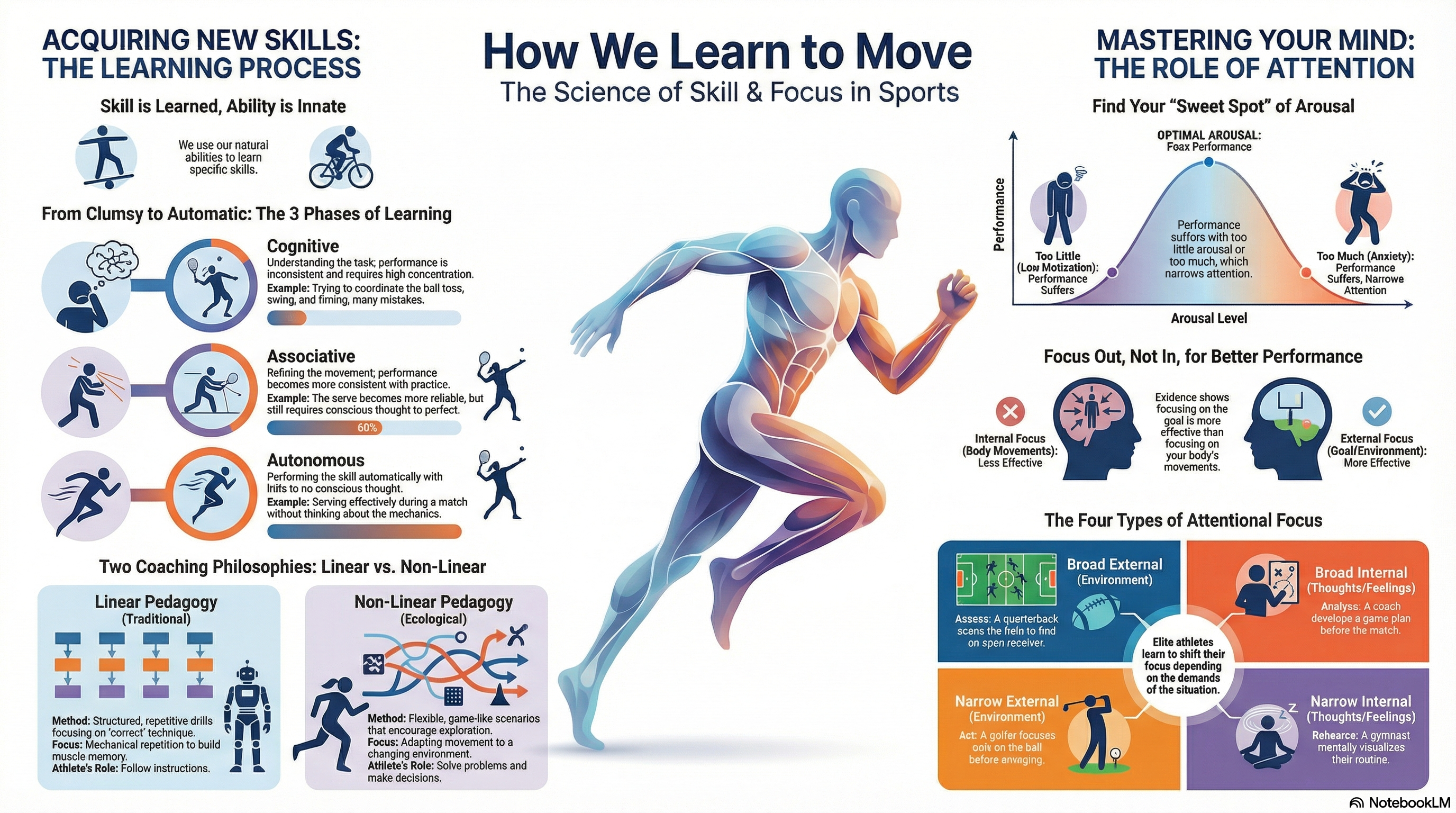
Mastering the specific terminology of motor learning is the foundation for understanding its complex theories and for answering exam questions with precision and clarity. A strong command of these terms allows you to articulate your knowledge accurately, demonstrating a deeper comprehension of the subject matter. The following list provides a concise reference for the essential vocabulary in this topic.
Understanding this terminology is the first step toward successfully navigating the structure of the IB SEHS examination.
Command terms are the specific directives in exam questions that signal the depth of knowledge and type of response required. A precise understanding of their meaning is essential for structuring answers that meet the full requirements of the markscheme and achieve the highest possible marks.
| Command Term | Official IB Definition | Topic C.2 Example with Model Answer |
|---|---|---|
| State | Give a specific name, value or other brief answer without explanation or calculation. |
Question: State the three phases of learning as
described by
Fitts and
Posner. Model Answer: Cognitive, associative, and autonomous. p.456 |
| Outline | Give a brief account or summary. |
Question: Outline the key differences between
linear and
non-linear
pedagogy. Model Answer: Linear pedagogy is a traditional, coach-centred approach where skills are broken down and taught sequentially through repetition, moving from simple to complex. p.449, 469 Non-linear pedagogy is a learner-centred approach based on an ecological dynamics framework, using exploratory learning and manipulation of constraints to develop adaptable movement solutions in varied performance contexts. p.449, 469 |
| Describe | Give a detailed account. |
Question: Describe the psychological refractory
period
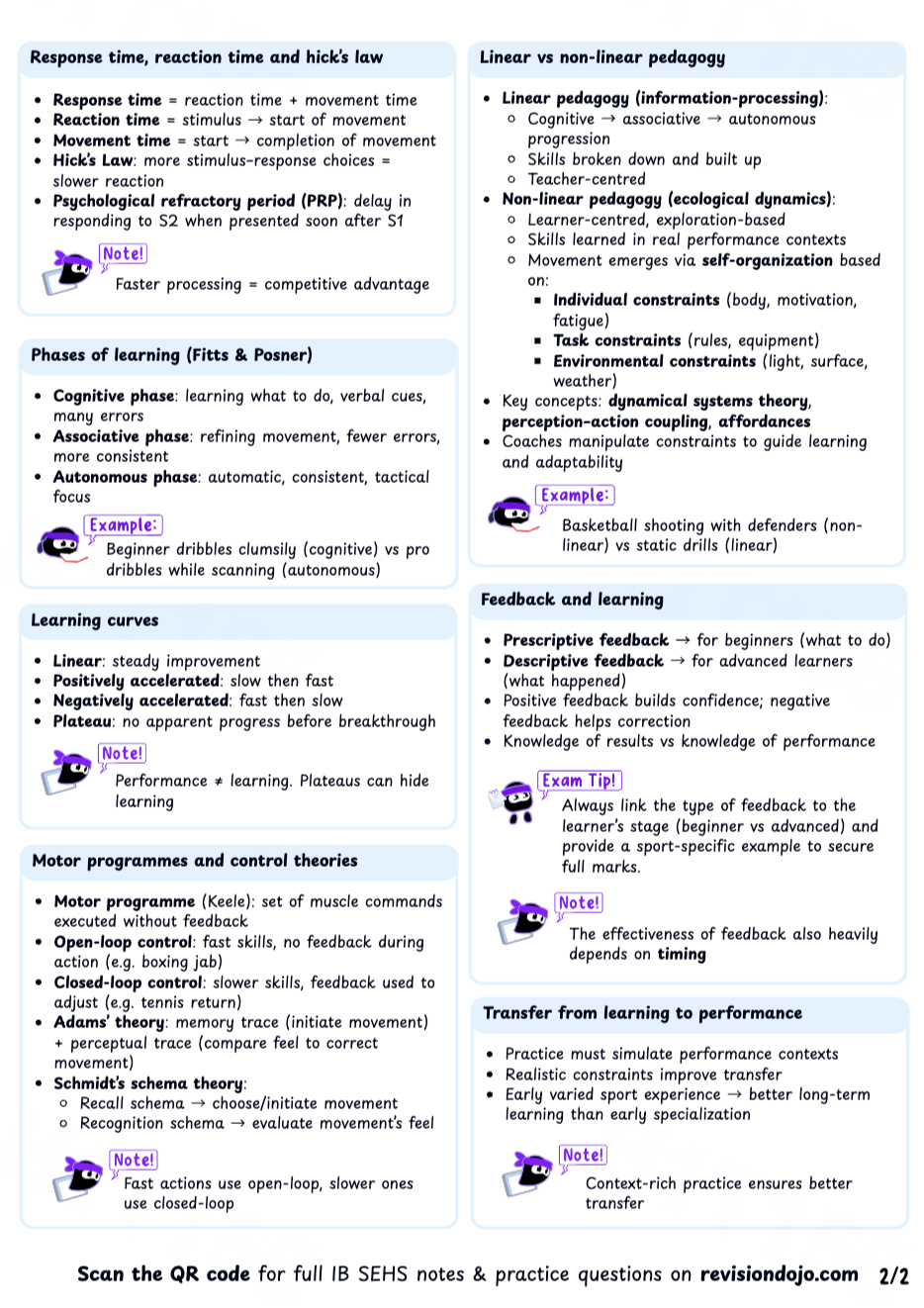
(PRP). Model Answer: The psychological refractory period occurs when two stimuli are presented in close succession. It refers to the delay in responding to the second stimulus because the first stimulus is still being processed by the brain's single-channel information processing system. Welford (1968) demonstrated that if a second stimulus is presented before the response to the first is completed, the reaction time to the second stimulus is significantly longer. A common sporting example is a soccer player faking a shot (stimulus 1) before making the actual move (stimulus 2), causing the defender to react slowly to the real movement. p.455-456 |
| Explain | Give a detailed account including reasons or causes. |
Question: Explain why an external focus of
attention generally
leads to
better performance than an internal focus. Model Answer: An external focus of attention, which directs attention to the intended movement effect (e.g., the ball hitting the target), is generally more effective because it promotes a more automatic and efficient mode of motor control. Studies show that an external focus speeds up the learning process and improves accuracy, consistency, and efficiency. This is because focusing externally allows the motor system to self-organize without conscious interference. In contrast, an internal focus on body movements (e.g., the position of one's arm) can disrupt this automaticity, leading to less efficient movement and slower performance. p.486 |
| Analyse | Break down in order to bring out the essential elements or structure. |
Question: Analyse Welford's information processing
model
(1968). Model Answer: Welford's model breaks down information processing into a sequence of stages. It begins with Input from the environment, which is received by the senses in the Sensation stage. This sensory information is then interpreted in the Perception stage, where it is compared to past experiences stored in long-term memory. The next stage is Decision, where the performer selects an appropriate response. The motor programme for this response is organized in the Efferent organization stage. Finally, the selected action is carried out as Output. The success of this output provides Feedback, which informs future actions and completes the processing loop. Although presented linearly, these processes can occur simultaneously. p.451 |
| Evaluate | Make an appraisal by weighing up the strengths and limitations. |
Question: Evaluate the use of a non-linear
pedagogical approach
to coaching
motor skills. Model Answer: Non-linear pedagogy offers significant strengths but also has potential limitations. Strengths: 1. It promotes adaptability by exposing learners to varied practice contexts, which helps them develop flexible and effective movement solutions that transfer well to dynamic game situations. p.469 2. It is learner-centred and enhances motivation by providing opportunities for autonomy, competence, and relatedness, for example, through small-sided games where learners make their own decisions. p.469 Limitations: 1. For highly complex or dangerous skills (e.g., skydiving), a more structured, reductionist approach may be necessary initially to ensure safety and build foundational competence. p.470 2. Some athletes, particularly those returning from injury or lacking confidence, may benefit from the structure and repetition of traditional drills to rebuild specific movement patterns before reintegrating into a more dynamic, non-linear environment. p.470 |
| Calculate | Obtain a numerical answer showing the relevant stages in the working. |
Question: Using the data in Table 1, calculate the
improvement
in
anterior-posterior stability for the external focus group following
the
intervention. Model Answer: Method: Improvement = Pre-test score - Post-test score (since higher scores mean lower stability). Working: External group pre-test anterior-posterior stability score = 12.8 External group post-test anterior-posterior stability score = 7.7 Improvement = 12.8 - 7.7 = 5.1 Answer: The improvement in anterior-posterior stability for the external focus group was 5.1. p.491 |
Having examined how to answer questions, we now turn to a review of the core content itself.
C.2.1 Motor learning processes
This sub-topic establishes the foundational principles of how we acquire and refine motor skills. It explores the critical distinction between innate ability and learned skill, the difference between a temporary performance and permanent learning, and the models that describe how our brains process information to produce movement. Understanding these processes is strategically vital for coaches and athletes, as it provides the theoretical framework for designing effective practice, providing feedback, and navigating the journey from novice to expert.
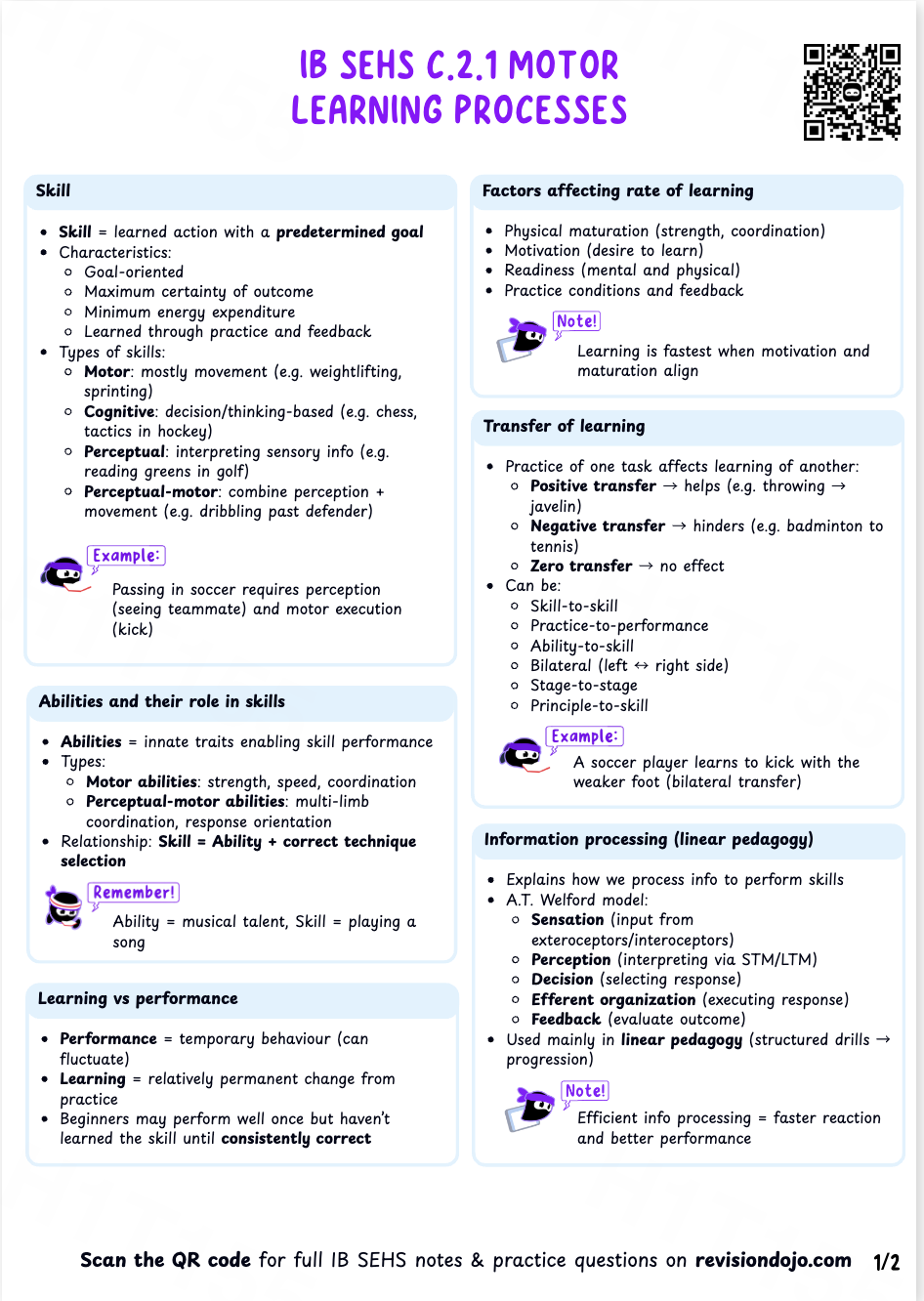
- Skill vs. Ability: A skill is learned, whereas an ability is an innate trait we are born with. Abilities are the perceptual and motor attributes that give us the capacity to perform skills. p.447
- Learning vs. Performance: Performance is a temporary display of a skill that can fluctuate, whereas learning is a relatively permanent change in the ability to perform that skill, resulting from practice or experience. p.448
- Transfer of Learning: This refers to how previous experience with one skill affects the learning or performance of another. This transfer can be positive (helping), negative (hindering), or zero (no effect). p.449
- Information Processing: This is a framework for understanding how humans take in information from the environment, process it, and use it to produce a motor response. p.450
Welford's (1968) model outlines a sequence of stages for processing information:
- Input: Information from the environment (the display or stimulus).
- Sensation: The senses (e.g., vision, audition) receive information from the input.
- Perception: The brain interprets the sensory information based on past experiences stored in long-term memory.
- Decision: A response is selected from available options.
- Efferent organization: The chosen motor programme is retrieved and prepared for execution.
- Output: The physical action or response is performed.
- Feedback: Information about the outcome of the output is received, which can be used to modify future actions. p.451
Fitts and Posner (1967) proposed that motor learning progresses through three distinct phases:
- Cognitive Phase: The beginner tries to make sense of the instructions. Performance is inconsistent, with many mistakes. The performer requires significant attention and may use verbalization to aid memory (e.g., "pull, brake, switch, slide").
- Associative Phase: With practice, the individual develops an understanding of what to do. They begin to perfect the skill and develop consistent, coordinated movement. Practice is essential to refine the skill.
- Autonomous Phase: The performer can execute the skill consistently with little overt cognitive activity. The skill is automatic, allowing the individual to focus on other aspects of performance, such as strategy. p.456
The psychological refractory period (PRP) is demonstrated effectively in sports involving deception. For example, in basketball, a player might fake a shot (the first stimulus, S1). The defender begins to react to this fake. The offensive player then immediately performs the actual movement, such as a drive to the basket (the second stimulus, S2). Because the defender is still processing and responding to S1, their response to S2 is significantly delayed, giving the offensive player an advantage. Similar feints are seen in soccer and boxing. p.456
C.2.2 Attentional control
This sub-topic delves into the cognitive mechanisms that govern focus and concentration, which are hallmarks of elite performance. It examines how athletes direct their mental effort, filter out distractions, and manage the relationship between their physiological arousal and their ability to process information. For coaches and athletes, mastering attentional control is a key strategic goal, as the ability to focus on the right cues at the right time is often what separates success from failure in high-pressure sporting environments.
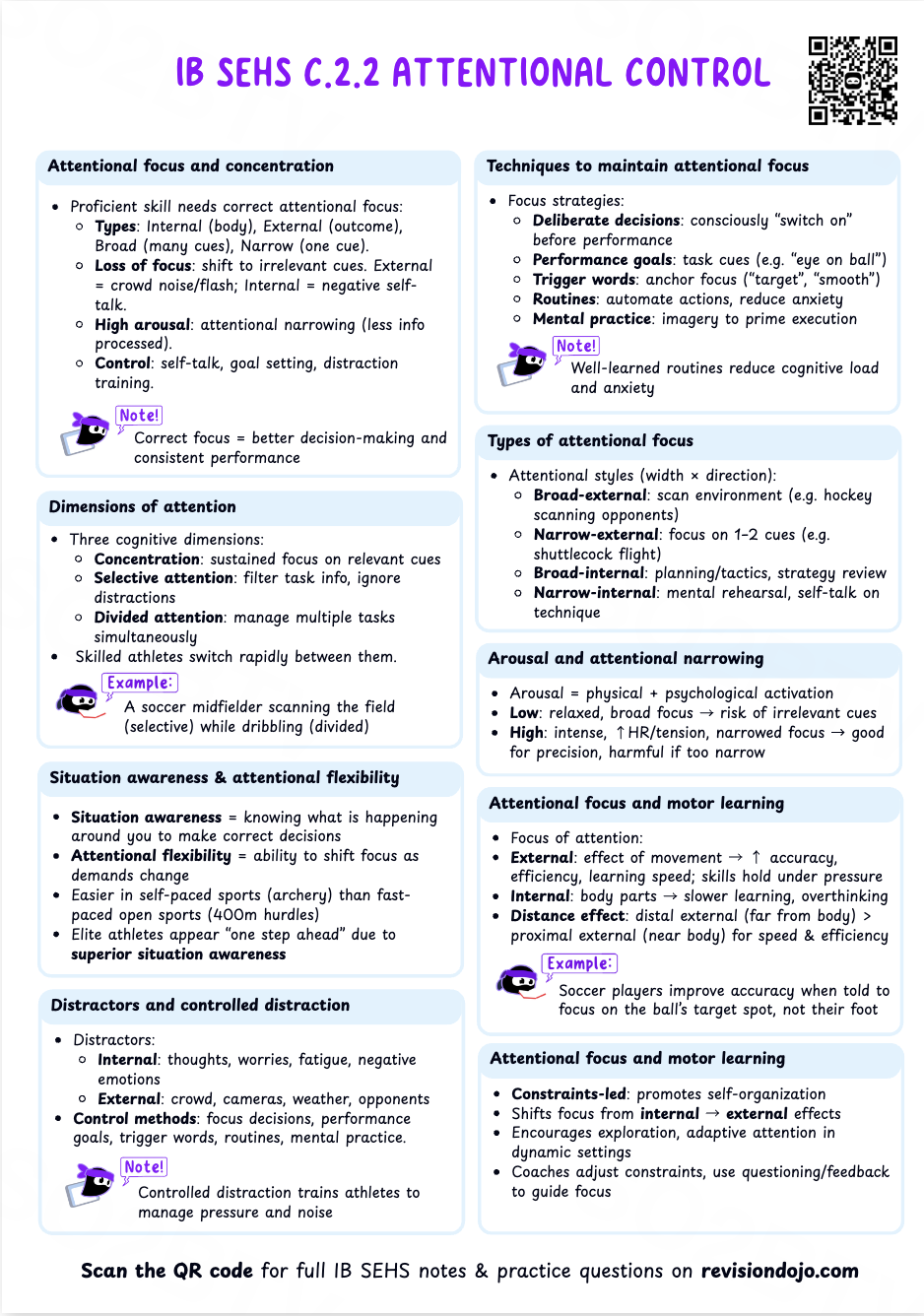
- Attentional Focus Dimensions: Attention can be viewed along two dimensions: width (broad or narrow) and direction (internal or external). This creates four types of focus: broad external, broad internal, narrow external, and narrow internal. p.482
- Distractors: Athletes can lose concentration due to internal distractors (e.g., thoughts, worries, fatigue) and external distractors (e.g., crowd noise, opponent actions, weather). p.479
- Arousal: This is the level of physical and psychological activation, ranging from low (relaxed) to high (intense). High arousal is linked to increased heart rate, rapid breathing, and feelings of excitement or anxiety. p.484
- Attentional Narrowing: A tendency for individuals to focus their attention on a limited set of cues when in a state of high arousal. p.484
Increased arousal triggers a predictable effect on attention:
- As an athlete's arousal level increases, their attentional field begins to narrow.
- This can be beneficial, as it helps the athlete filter out irrelevant distractions and focus on the most important cues (e.g., a basketball player focusing only on the rim and ball during a free throw).
- However, if arousal becomes too high, the attentional field can become excessively narrow.
- This negative effect causes the athlete to miss important peripheral cues (e.g., an open teammate), leading to a reduction in overall performance. p.484
An elite golfer teeing off in front of a crowd provides an excellent example of managing attentional focus.
Controlled Distraction: The golfer first acknowledges potential environmental distractors like wind, hazards (water, bunkers), and the shape of the fairway. They direct their attention to these factors to make an informed plan.
Pre-Shot Routine: The golfer then narrows their focus using a well-learned routine. This may involve visualizing the ball's trajectory, using a trigger word like "target," and focusing exclusively on the execution of the swing. This routine helps to block out negative thoughts and external distractions, ensuring attention remains on the task-relevant information required for a successful shot. p.480-481
Understanding this theory is essential, but applying it through practice is what builds exam readiness.
Consistently applying knowledge through exam-style questions is the most effective method to consolidate learning, identify weaknesses, and master the application of concepts for the exam. This section provides a range of questions designed to test your understanding of Topic C.2.
Why A is wrong: This describes the cognitive phase, where the beginner is trying to make sense of the skill.
Why B is wrong: This describes the autonomous phase, where the skill is automatic.
Why D is wrong: Focusing on tactics and strategy is a characteristic of the autonomous phase, as cognitive resources are freed from controlling the movement itself.
Why A is wrong: Broad external focus involves assessing a situation externally, such as an ice hockey player dribbling and avoiding opponents.
Why C is wrong: Narrow external focus is directed at one or two external cues, such as a tennis player tracking the ball.
Why D is wrong: Narrow internal focus involves mentally rehearsing a specific upcoming performance, like a gymnast going through their routine.
Why A is wrong: This describes closed-loop control.
Why C is wrong: This describes the mechanism of closed-loop control, where the perceptual trace is compared to the memory trace.
Why D is wrong: Open-loop skills are generally more effective in stable, predictable environments where a pre-planned movement can be executed successfully.
Why A is wrong: This describes linear pedagogy, which is teacher-centred.
Why B is wrong: This is a characteristic of a reductionist, linear approach.
Why D is wrong: This describes linear pedagogy; non-linear pedagogy is flexible and adaptable.
The questions below provide insight into the types of challenges you will face in Paper 1B. Unlike standard knowledge checks, this component places a distinct emphasis on data analysis and experimental work.
Success in Paper 1B requires you to apply the "Nature of Science" (NOS) skills—such as evaluating methodologies, interpreting graphs, and understanding study design—rather than simply recalling course content.
To access a complete archive of true past papers and exemplar materials for Paper 1B, please use the resource link below.
Note: Image from source not reproducible, description provided
Description: A graph with time on the x-axis and muscle activity (EMG) on the y-axis.
• a represents the time from "READY" to the "GO" stimulus.
• b represents the time from "GO" to the start of muscle activity.
• c represents the initial muscle contraction (elbow flexion).
• d represents the duration of the muscle activity until the "STOP" signal.
Identify the time interval that represents reaction time. [1 mark]
A teammate shouts a fake instruction just before the "GO" signal. Explain the likely effect on the duration of interval 'b', using an appropriate motor learning term. [2 marks]
Evaluate the use of EMG as a tool for measuring motor performance in this context. [2 marks]
Note: Image from source not reproducible, description provided
Description: A bar chart showing mean sprint times for three conditions.
• Control: 32.1 s
• Proximal: 32.0 s
• Distal: 30.8 s
State which focus condition resulted in the fastest sprint time. [1 mark]
Calculate the percentage improvement in sprint time for the distal focus condition compared to the control condition. [2 marks]
Working: ((32.1 - 30.8) / 32.1) * 100 = (1.3 / 32.1) * 100 = 4.05%
Answer: The percentage improvement was approximately 4.05%. [2]
Explain the results of this study in the context of attentional focus theory. [3 marks]
| Attentional focus | Stability score | pre | post |
|---|---|---|---|
| internal | overall stability | 16.7 | 14.2 |
| anterior-posterior | 12.5 | 10.3 | |
| medial-lateral | 11.6 | 9.8 | |
| external | overall stability | 16.9 | 11.4 |
| anterior-posterior | 12.8 | 7.7 | |
| medial-lateral | 12.2 | 8.1 |
Identify which group had the better overall stability at the start of the intervention. [1 mark]
Describe the effect of the intervention on medial-lateral stability for the external focus group. [2 marks]
Discuss the implications of these findings for designing balance training programs for older adults. [3 marks]
Note: Image from source not reproducible, description provided
Description: Four graphs with time on the x-axis and performance on the y-axis.
• Curve a: A straight line showing a constant rate of improvement (linear).
• Curve b: Starts with slow improvement, then the rate of improvement accelerates (positively accelerated).
• Curve c: Starts with rapid improvement, which then slows down over time (negatively accelerated).
• Curve d: Shows periods of improvement interspersed with a period of no improvement (a plateau).
Identify which curve represents a negatively accelerated learning curve. [1 mark]
Explain why a learning curve like 'd' might occur when a skilled athlete is learning a new, complex technique. [2 marks]
Evaluate the statement "Learning curves are a direct and accurate measure of learning." [3 marks]
(a) Describe the characteristics of a linear pedagogical approach the coach might use. [4 marks]
(b) Explain how the learners would progress through the cognitive and associative phases of learning in this scenario. [4 marks]
(b) In the cognitive phase, the novices would be trying to understand the basic mechanics of the shot. They would be highly reliant on the coach's instructions and demonstrations. Their movements would be uncoordinated, inconsistent, and they would make many errors (e.g., shooting with two hands, incorrect footwork). They would need to concentrate fully on each component of the skill. As they practice, they would transition to the associative phase. Here, they begin to link the different parts of the free throw into a smoother motion. Their performance would become more consistent, and they would be able to recognize and start correcting their own errors. Practice is key in this phase to refine the movement pattern and make it more fluid and accurate. [4]
This moves us from qualitative application to the quantitative skills required for the course.
While Topic C.2 is primarily theoretical, the ability to interpret data from graphs and tables and perform basic calculations is a required analytical skill for the data-based questions in Paper 1. Calculations in this topic are minimal and typically involve finding differences, means, or percentage changes.
Task: Calculate the improvement between the pre- and post-test anterior-posterior stability scores for the external focus group.
Data: From Table 1: Attentional focus and postural control in older adults. p.491
- Pre-test score (external, anterior-posterior): 12.8
- Post-test score (external, anterior-posterior): 7.7
Working
- Improvement = 12.8 – 7.7
Answer
The improvement is 5.1. (Note: A larger positive result indicates greater improvement, as higher scores mean lower stability).
Performing these calculations correctly is important, but it is equally important to understand how to avoid common conceptual mistakes.
Proactively learning from common student mistakes is a highly effective revision strategy. By understanding these specific pitfalls in advance, you can avoid them in your own assessments and demonstrate a more nuanced understanding of the topic.
Avoiding these errors will help you build connections between concepts, a critical skill for the IB SEHS course.
The IB SEHS course promotes a holistic understanding of sports science, where the ability to synthesize information and connect concepts across different topics is a hallmark of higher-order thinking. These questions challenge you to look beyond Topic C.2 and integrate your knowledge from across the syllabus.
- Explain the relationship between arousal and attention: as arousal increases, the attentional field narrows. p.484
- Discuss how high anxiety (C.1) can cause excessive arousal, leading to negative attentional narrowing where an athlete misses important environmental cues.
- Consider how psychological skills training from C.1 (e.g., controlled breathing, visualization) can help an athlete regulate their arousal to maintain an optimal attentional focus.
- Consider how video provides immediate, augmented feedback, which is crucial during the cognitive and associative learning phases.
- Link to biomechanical analysis (B.2.3), where video can be used to break down technique and compare a learner's performance against an elite model.
- Discuss how post-performance video review allows for reflection and self-assessment, helping to move a skill into the autonomous phase. p.473
To confirm your grasp of these concepts, use the following self-assessment checklist.
This checklist is a final tool for active revision and self-assessment, enabling you to confirm your mastery of the key learning objectives for Topic C.2. Use these prompts to actively recall and articulate your understanding, identifying any areas that may require further review.
- Can I define skill and distinguish it from ability?
- Can I describe the information processing model and explain the function of each stage?
- Can I outline the three phases of motor learning with sporting examples for each?
- Can I distinguish between linear and non-linear pedagogy?
- Can I describe the different types of attentional focus using the two-dimensional model?
- Can I explain the relationship between arousal and attentional narrowing?
- Can I discuss the evidence supporting the use of an external focus of attention for skill acquisition?
- Can I explain the psychological refractory period using a sporting example?
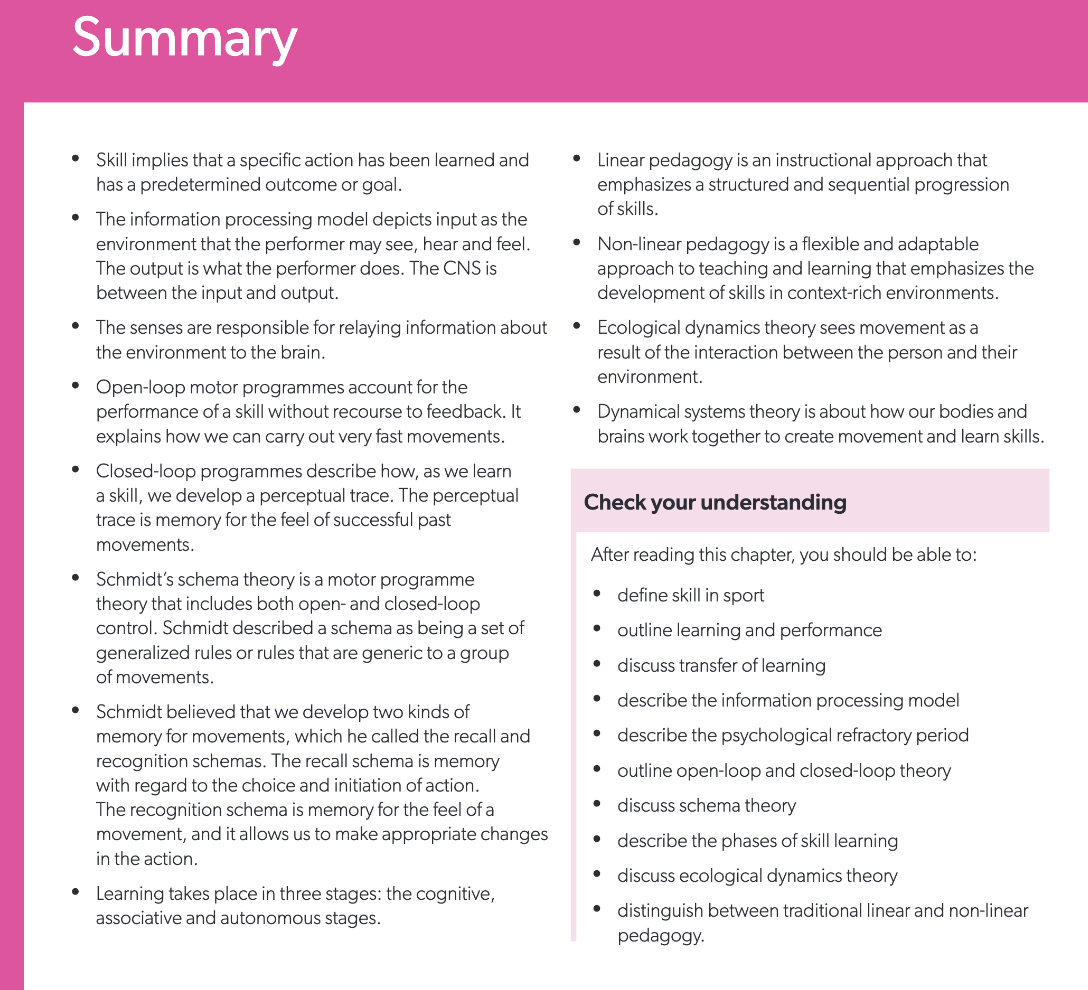
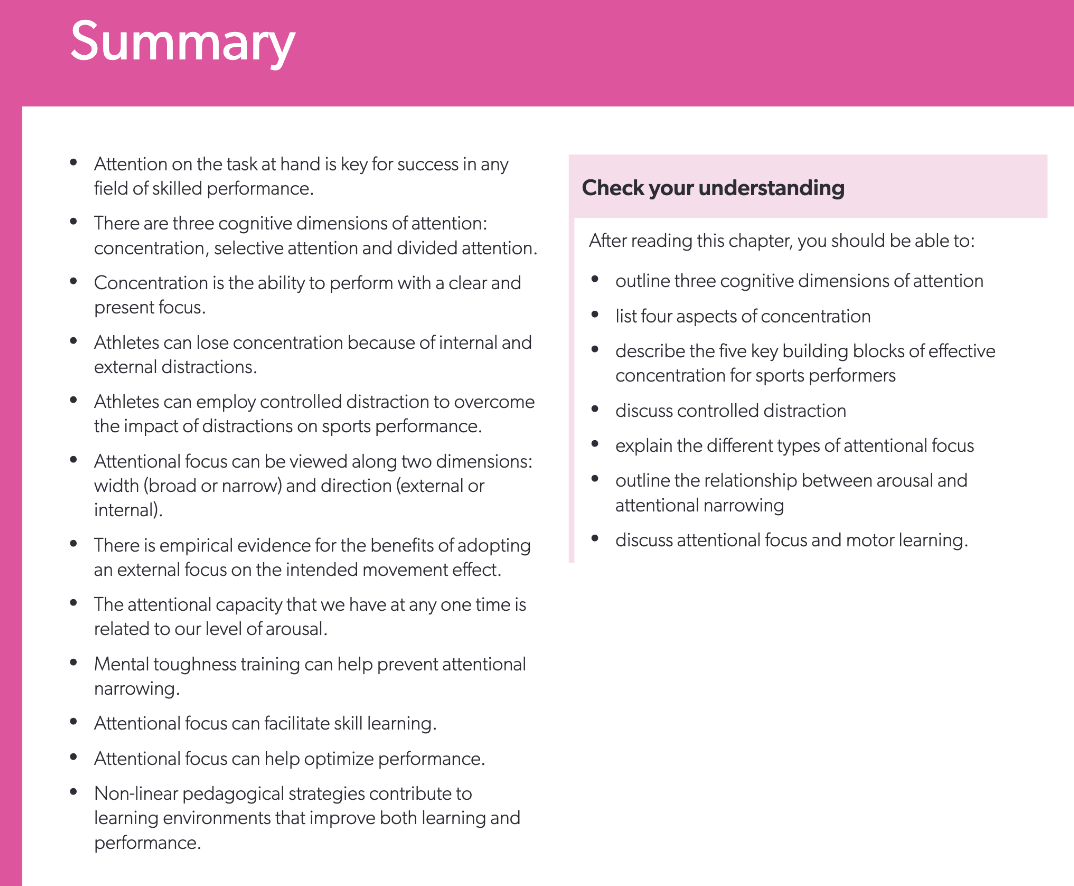
🎉 Topic C2 - Motor Learning Mastered!
You have successfully completed your comprehensive review of motor learning. Keep practicing with exam-style questions to reinforce your understanding.