Topic C.4 Stress and Coping
IB SEHS Study Guide
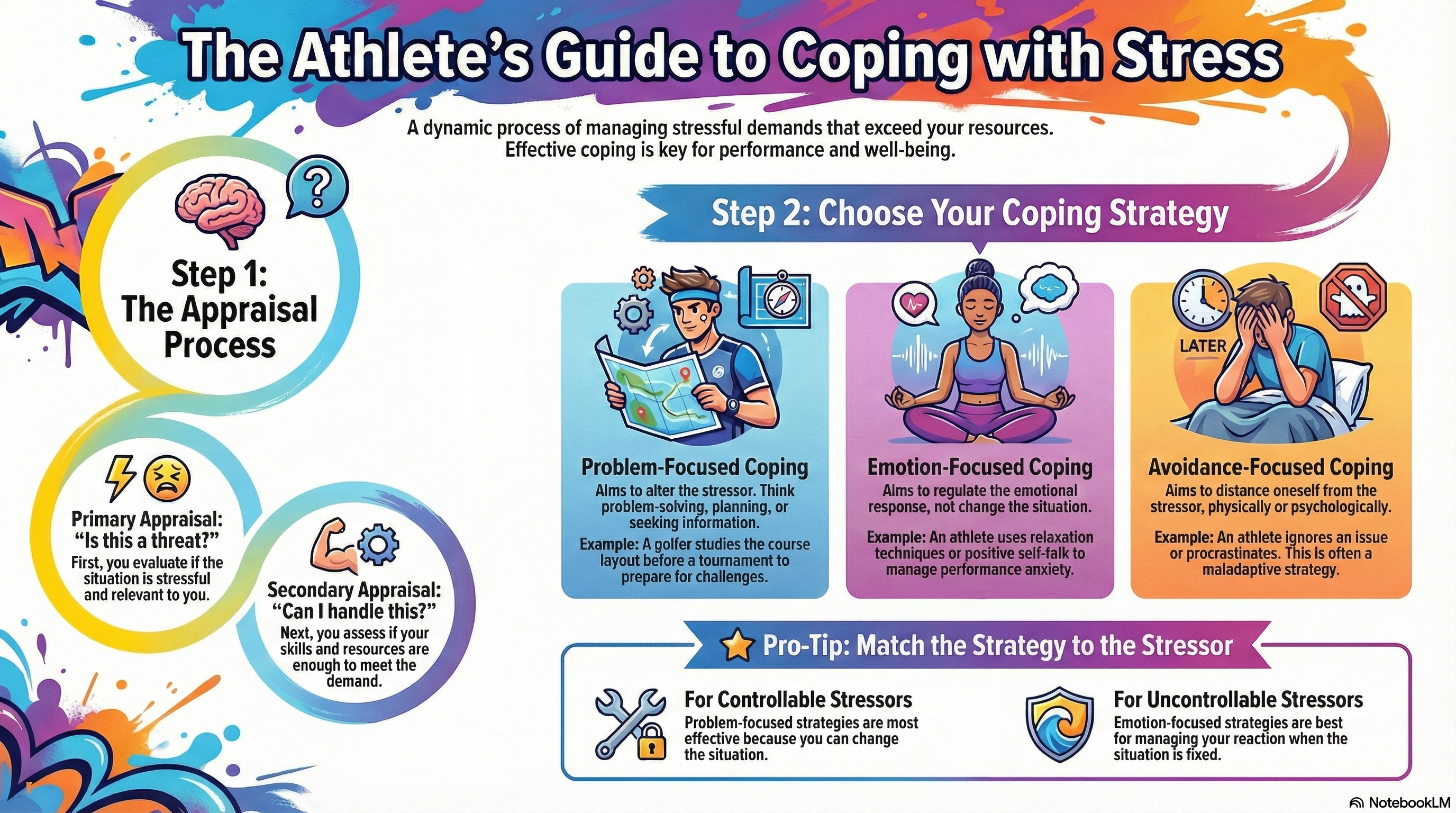
Mastering the specific vocabulary of sport psychology is fundamental for clear and precise communication in your IB SEHS exams. These terms are not just words to memorize; they are the building blocks for understanding how athletes perceive, interpret, and respond to the pressures of competition. A firm grasp of this terminology will enable you to construct sophisticated and accurate responses.
The key terms for this topic can be grouped by their core functions:
Mastery of these terms prevents the "vague phrasing" that frequently leads to mark loss. For example, using "stress" as a synonym for "somatic anxiety" ignores the specific physiological activation requirements of the 2026 syllabus. Precise terminology is the primary tool for earning marks in Paper 2's "Explain" and "Analyse" questions.
Seeing how these terms are applied is best demonstrated within the context of the exam structure itself.
This structure provides the framework for the exam, but the command terms dictate the specific way in which you must formulate your answers within that framework.
IB command terms are precise directives that tell you exactly what is expected in your answer. Misinterpreting a command term is a common reason for losing marks, even if you know the content well. Understanding the specific demand of each term is key to crafting high-scoring answers that directly address all parts of the question.
Here are some key command terms you will encounter, with examples relevant to this topic:
| Command Term | Official IB Definition | C.4 Model Answer |
|---|---|---|
| State | Give a specific name or brief answer. | State one objective measure of anxiety. Answer: Galvanic skin response. |
| Outline | Give a brief account or summary. | Outline self-talk. Answer: An internal dialogue used by athletes to regulate emotions or trigger technical actions. |
| Describe | Give a detailed account. | Describe the IZOF. Answer: A theory stating that each athlete has a specific personal arousal range where they perform optimally, rather than a single point. |
| Explain | Give a detailed account including reasons. | Explain the role of the sympathetic nervous system in
arousal. Answer: It initiates the fight-or-flight response, increasing heart rate and respiration to prepare the body for action. |
| Analyse | Break down to bring out essential elements. | Analyse the impact of high ego orientation. Answer: If perceived ability is low, high ego leads to anxiety [1] as the individual fears negative social comparison [1]. |
| Evaluate | Weigh strengths and limitations. | Evaluate the Inverted U Theory. Strengths: Simple to apply; identifies an optimal point. Limitations: Fails to account for cognitive anxiety; too simplistic for complex motor tasks. |
| Calculate | Obtain a numerical answer showing working. | Calculate the % change in Heart Rate (HR) from rest (70 bpm) to
pre-competition
(105
bpm). Working: ((105 - 70) / 70) x 100 = 50%. Answer: 50% increase. |
Failure to structure an "Analyze" response as a breakdown of constituent parts (e.g., the interaction between cognitive and somatic anxiety) is a leading cause of mark loss. Use "because," "therefore," and "consequently" to link your points.
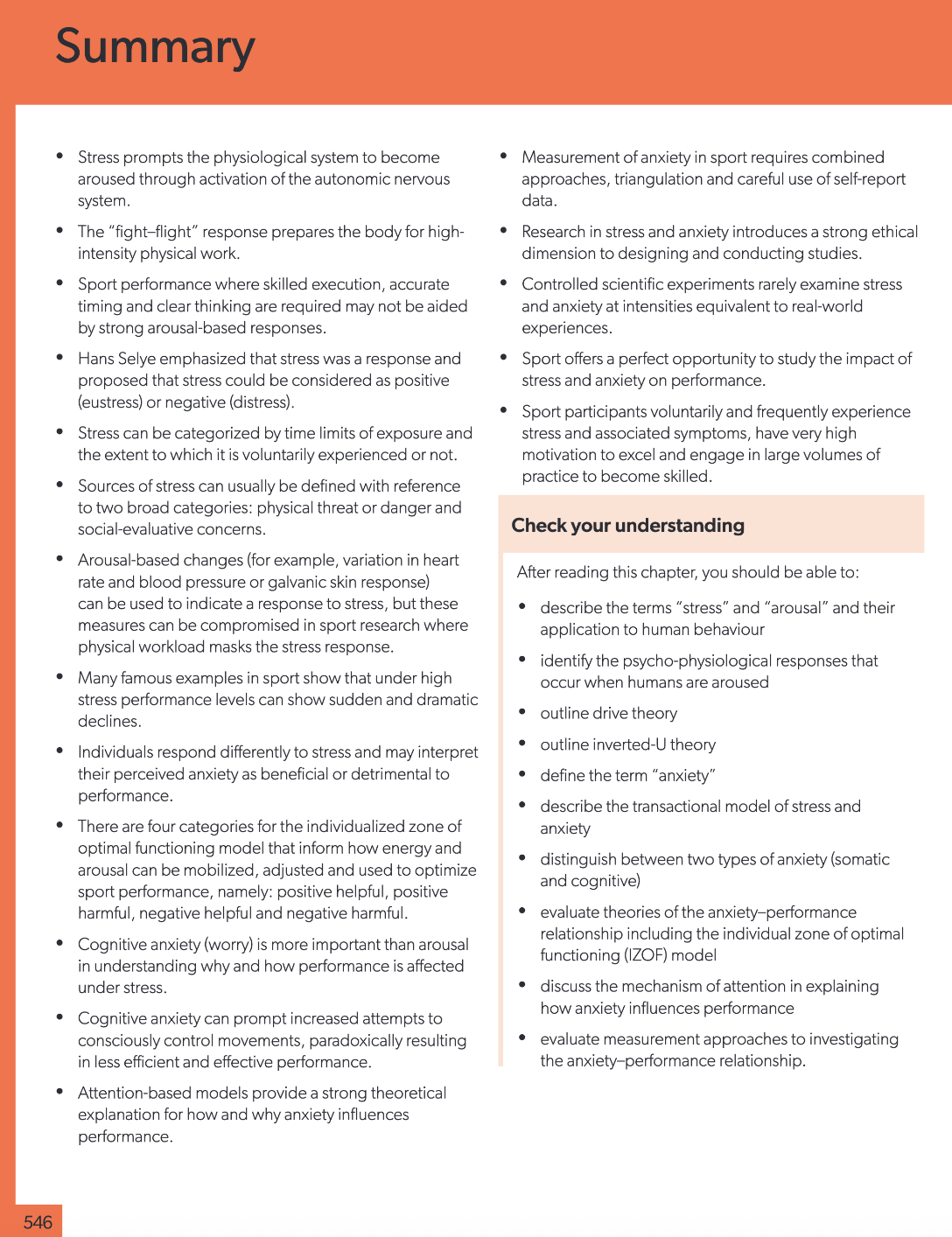
This topic is framed by the guiding question: "How do humans perceive and respond to stress during physical activity?" At its core, Topic C.4 explores the psychological and physiological mechanisms that determine how athletes handle pressure, from the neutral activation of arousal to the complex strategies of coping. This section summarizes the core content, structured around the IB's official 'Developing Understandings,' giving you a direct window into what your examiners consider most important.
C.4.1 Arousal and Anxiety p. 48
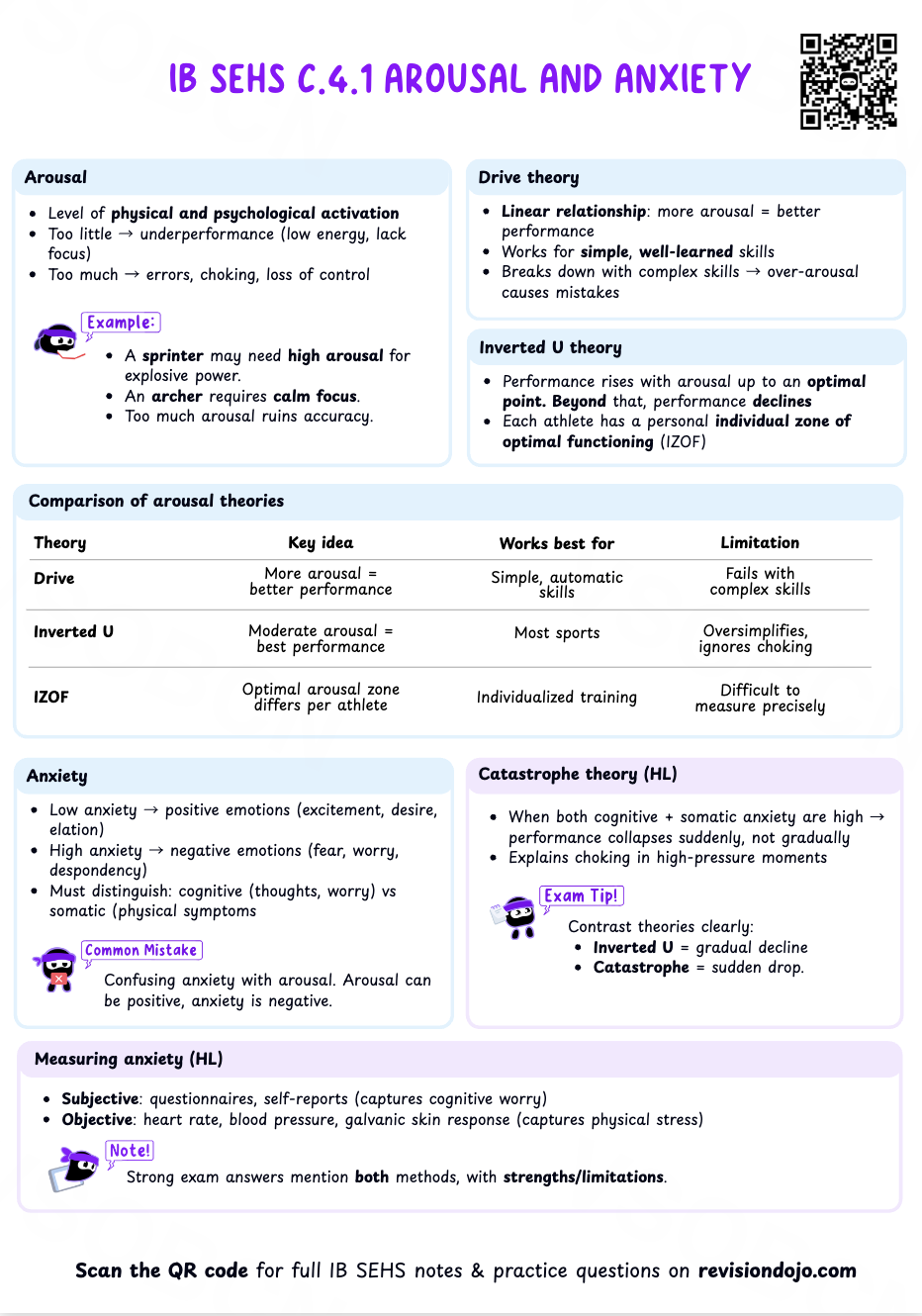
Arousal is the physiological "engine" of performance. However, without management, high arousal coupled with high cognitive anxiety creates technical and psychological collapse.
Key Concepts: Drive Theory, Inverted U Theory, IZOF, Catastrophe Theory, Somatic vs. Cognitive Anxiety.
- Openness: Willingness to try new training methods.
- Conscientiousness: Tendency for goal-directed, socially acceptable behavior.
- Extraversion: Drawing energy from social interaction (team environments).
- Agreeableness: How well an individual relates to others.
- Neuroticism: The extent to which an individual perceives situations as distressing (highly linked to anxiety).
- Condition: Cognitive anxiety (worry) must be high.
- Ascension: As somatic arousal increases toward an optimal threshold, performance remains high.
- The Catastrophe: If arousal exceeds the threshold, performance "crashes" or ends prematurely. This is a sudden vertical drop, not a gradual curve.
In a championship tennis match, a player with high worry (cognitive) may experience a "catastrophe" after a double fault increases their heart rate (somatic) beyond their limit, leading to a complete technical breakdown and loss of the set.
Examiners penalize students who treat "Arousal" and "Anxiety" as synonyms. Arousal is a neutral state of activation; anxiety is a negative emotional interpretation of that activation.
C.4.2 Coping p. 49
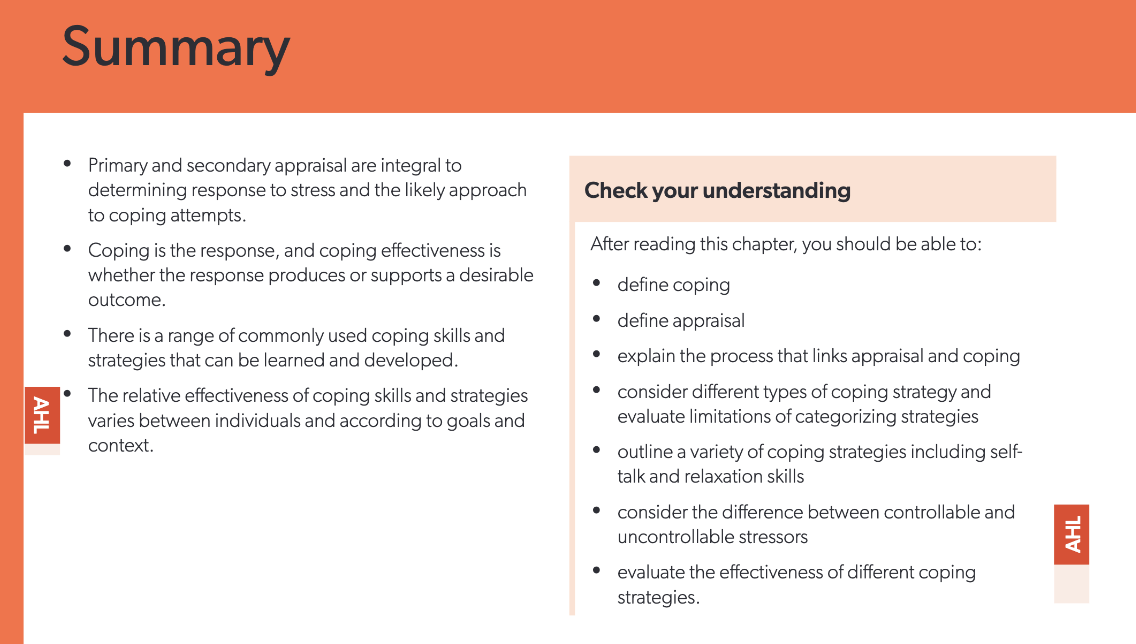
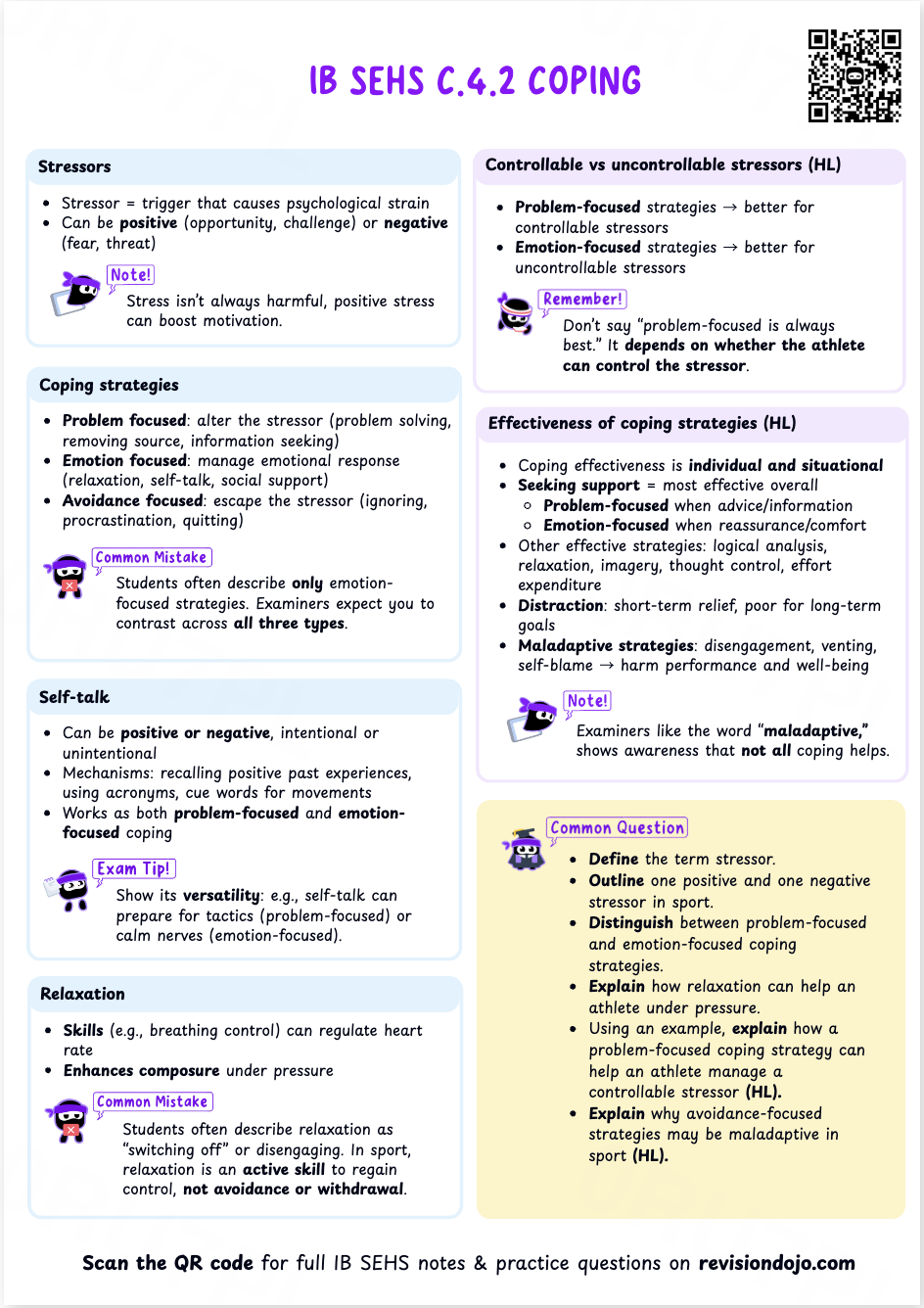
Coping strategies are the tools used to maintain homeostasis. Their effectiveness is strictly dictated by the "controllability" of the stressor.
Key Concepts: Problem-focused, Emotion-focused, and Avoidance-focused coping; Self-talk; Relaxation; Social support.
Maladaptive Strategies: These hinder goal attainment and include venting (unpleasant emotional outbursts), self-blame, and mental/physical disengagement (withdrawal).
- Recall: Accessing positive past experiences.
- Acronyms: Using "cue words" (e.g., "SMOOTH") to trigger focus.
- Instruction: Describing a movement in one word (e.g., "SNAP") to simplify complex tasks.
A swimmer uses problem-focused coping by adjusting their goggles (controllable stressor) or emotion-focused coping (self-talk) to manage the fear of a stronger opponent (uncontrollable stressor).
Seeking support is the most effective coping strategy for athletes. It can be problem-focused (seeking technical advice) or emotion-focused (seeking comfort).
The 2026 syllabus emphasizes that problem-focused coping is superior for controllable stressors. Using an emotion-focused strategy (like relaxation) for a controllable issue (like incorrect equipment) is inefficient and may lead to performance decline.
Now that you have reviewed the core content, let's apply this knowledge through exam-style questions.
Applying your knowledge through practice is the best way to solidify your understanding and prepare for the demands of the IB exams. Because the source material for this guide is a Teacher Support Material, these questions are designed to model the exam format and test your grasp of the core concepts presented in the text.
(Source: Created based on facts in the SEHS Support Material)
Paper 1A: Multiple Choice Questions (MCQs)
Why A, C, and D are wrong: A, C, and D relate to goal-direction, social energy, and curiosity.
The questions below provide insight into the types of challenges you will face in Paper 1B. Unlike standard knowledge checks, this component places a distinct emphasis on data analysis and experimental work.
Success in Paper 1B requires you to apply the "Nature of Science" (NOS) skills—such as evaluating methodologies, interpreting graphs, and understanding study design—rather than simply recalling course content.
To access a complete archive of true past papers and exemplar materials for Paper 1B, please use the resource link below.
| Athlete | Practice HRV (ms) | Final HRV (ms) |
|---|---|---|
| 1 | 82 | 45 |
| 2 | 78 | 42 |
| 3 | 90 | 51 |
| 4 | 85 | 48 |
| 5 | 80 | 44 |
Calculate the mean percentage change in HRV for the five athletes from practice to the final. [3]
Step 2: ((46 - 83) / 83) x 100 = -44.57%.
Answer: 44.6% decrease in HRV. [3]
Analyse the relationship between the competition environment and the athletes' physiological state. [3]
Evaluate the use of HRV as a measure of stress in this experiment. [3]
State which "Big Five" trait would most likely correlate with the largest drops in HRV. [1]
Having applied your knowledge, let's briefly review the mathematical skills required for this topic.
In Topic C.4, mathematical skills (Tool 3) provide the objective evidence required to validate psychological theories. Quantitative measures such as Heart Rate Variability (HRV) and Galvanic Skin Response (GSR) are essential for "triangulation"—pairing objective data with subjective questionnaires to improve assessment validity.
Worked Example: Heart Rate Variability (HRV) Change
An athlete's HRV (measured in milliseconds) drops during a high-pressure penalty.
- Pre-test: 85 ms
- Post-test: 52 ms
Step 1: Calculate the difference
- 52 - 85 = -33
Step 2: Divide by original value
- -33 / 85 = -0.3882
Step 3: Convert to percentage
- -0.3882 x 100 = -38.8%
Conclusion
Final Answer: 38.8% decrease in HRV.
Being able to quantify autonomic responses (via HRV or GSR) provides the statistical evidence needed to support a psychological analysis in Paper 2 or Paper 1B. Data interpretation is a Level 3 skill in the IB SEHS criteria.
Beyond quantitative skills, it is equally important to avoid common qualitative errors in your conceptual understanding.
The Correction: Arousal is activation; anxiety is a negative response to that activation.
The Correction: The "I" stands for Individual; zones are unique to each performer.
A key feature of the IB SEHS course is understanding how different topics connect and build upon one another.
These questions are designed to challenge your ability to synthesize knowledge from different topics within the SEHS syllabus. Success in Higher Level Paper 2 often depends on your capacity to make these inter-topical connections.
Making these connections is a powerful study technique. To ensure you have mastered the core ideas, use the following checklist to assess your learning.
Use this checklist as an active revision tool. Before you move on, honestly assess your confidence in each area. Check off the items you feel you have mastered and revisit the sections in your notes or this guide for those you are less sure about.
- I can distinguish between arousal and anxiety.
- I can explain the different types of anxiety (cognitive and somatic).
- I can evaluate theories of arousal-performance relationships (Drive, Inverted-U, IZOF, Catastrophe).
- I can identify various stressors and describe the stress process.
- I can distinguish between different coping strategies (problem-focused, emotion-focused, avoidance).
- I can evaluate the effectiveness of different coping strategies based on controllability.
🎉 Topic C.4 Stress and Coping Mastered!
Continue to review and apply these foundational concepts, as they will reappear and provide context for many other topics throughout the SEHS course.