Topic C5 - Psychological Skills
A comprehensive study guide covering goal setting and imagery in IB SEHS 2026.
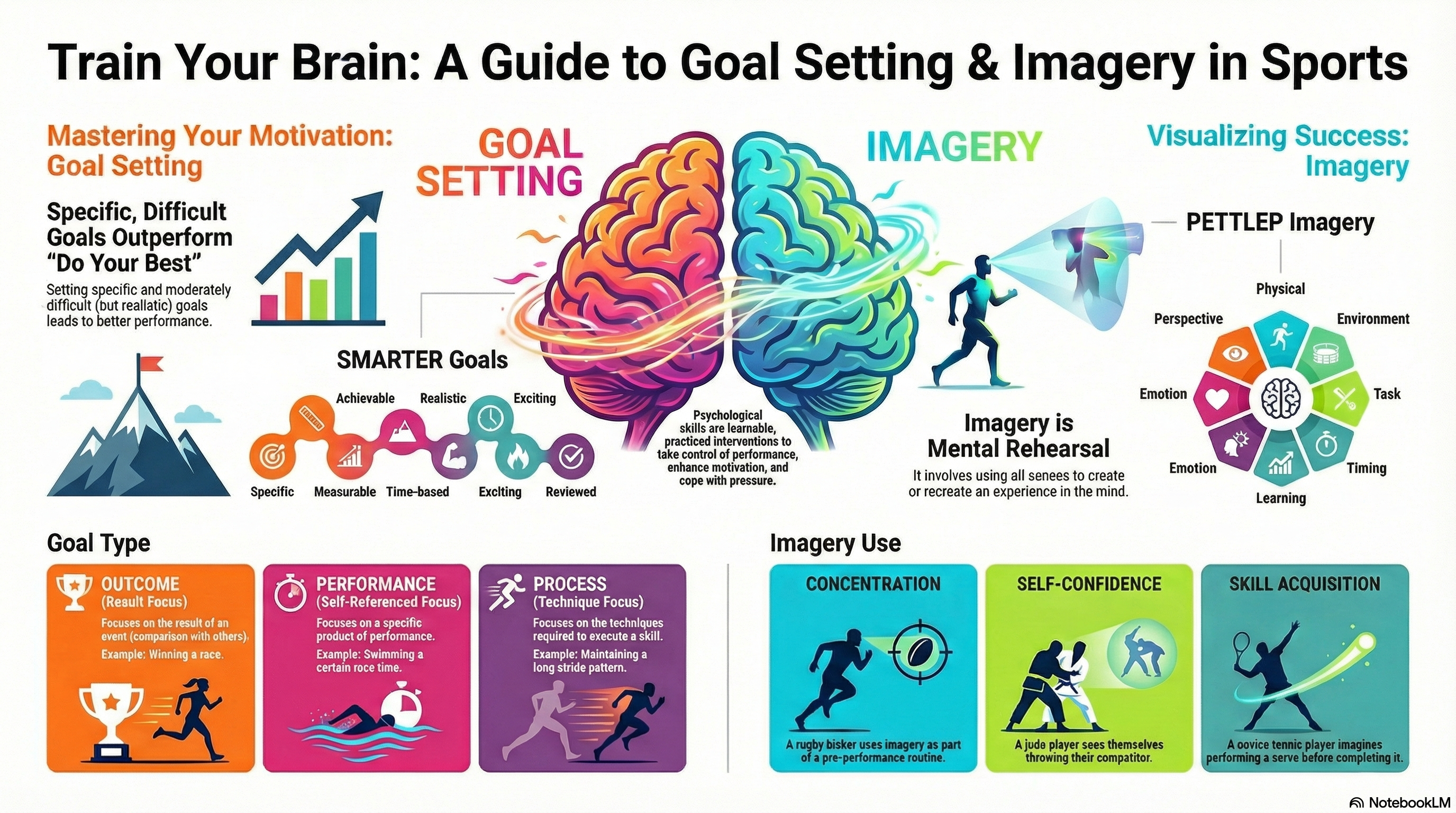
Mastering the precise terminology for Topic C.5, Psychological Skills, is fundamental to constructing clear, accurate, and high-scoring exam responses. These terms are not merely vocabulary; they are the conceptual building blocks for understanding how psychological interventions are designed and applied in sport, exercise, and health. A firm grasp of these definitions will enable you to analyse and evaluate psychological strategies with the required academic rigor.
The essential terms for this topic are grouped below by concept.
With these foundational terms established, it is crucial to understand the structure of the examinations where you will be required to apply this knowledge.
Understanding this overall structure provides the context for mastering the specific command terms that dictate how you must answer questions within these papers.
IB command terms are the essential instructions within an exam question that specify the required depth and breadth of your response. Misinterpreting a command term is a common reason for lost marks, even when a student possesses the necessary content knowledge. Mastering these terms is therefore non-negotiable for achieving success. The table below defines the key command terms and provides model answers grounded in the C.5 syllabus content.
| Command Term | Definition | C.5 Model Answer |
|---|---|---|
| State | Give a specific name, value or other brief answer without explanation or calculation. | State a process goal for a basketball player: A process goal for a basketball player is to maintain a high elbow position during every free-throw attempt. |
| Outline | Give a brief account or summary. | Outline Paivio's imagery framework (HL): Paivio's imagery framework outlines that imagery serves two main functions, cognitive and motivational, which can each be applied in either a specific or a general context. |
| Describe | Give a detailed account. | Describe the goal-setting paradox (HL): The goal-setting paradox is a phenomenon observed in elite athletes who report feeling less satisfied and a sense of deflation after achieving an extremely difficult long-term goal, compared to the satisfaction felt from achieving easier, more immediate goals. |
| Explain | Give a detailed account including reasons or causes. | Explain how imagery can be motivational (HL): Imagery can be motivational by allowing an athlete to visualize specific goals, such as winning a medal (motivational specific), or to imagine remaining calm and confident in a high-pressure situation, which helps regulate arousal and build self-efficacy (motivational general). |
| Analyse | Break down in order to bring out the essential elements or structure. | Analyse the use of different goal types for a marathon runner: A marathon runner would use an outcome goal (e.g., finish in the top 10) to provide long-term direction, a performance goal (e.g., achieve a personal best time) to maintain personal focus, and process goals (e.g., maintain a consistent cadence) to direct attention to the immediate technical aspects of running efficiently. |
| Evaluate | Make an appraisal by weighing up the strengths and limitations. | Evaluate the use of goal setting in sport: One strength is that goal setting provides a framework for objective feedback, allowing athletes and coaches to monitor progress and adjust training systematically. Another strength is its ability to direct an athlete's attention towards a specific task. However, it has limitations; the goal-setting paradox (HL) can lead to deflation in elite athletes upon goal achievement, and research suggests it is not universally effective, as some individuals perform better with more flexible "do-your-best" or "open" goals. |
| Calculate | Obtain a numerical answer showing the relevant stages in the working. | Topic C.5 is a qualitative topic that focuses on psychological theories and interventions. Therefore, the command term "Calculate" is not applicable as it does not involve mathematical formulas or calculations. |
Having learned how to interpret and respond to exam questions, we now turn to a detailed summary of the core content for Topic C.5.
This section provides a structured breakdown of the core theories and applications within Topic C.5, Psychological Skills, as detailed in the IB SEHS 2026 syllabus. The content is organized to align with the syllabus, distinguishing between concepts required for all students and those exclusive to Higher Level.
C.5.1 Goal Setting (SL/HL)
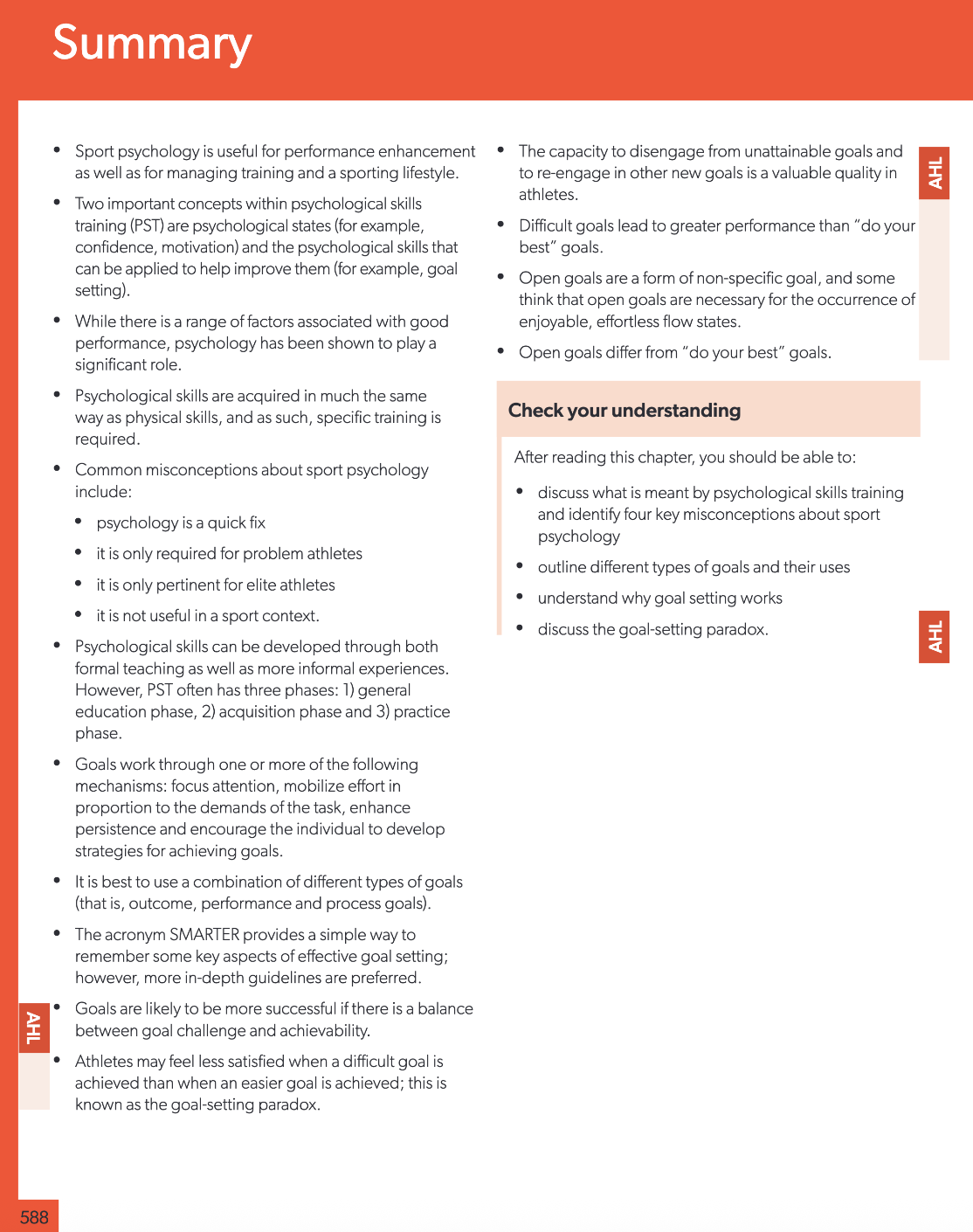
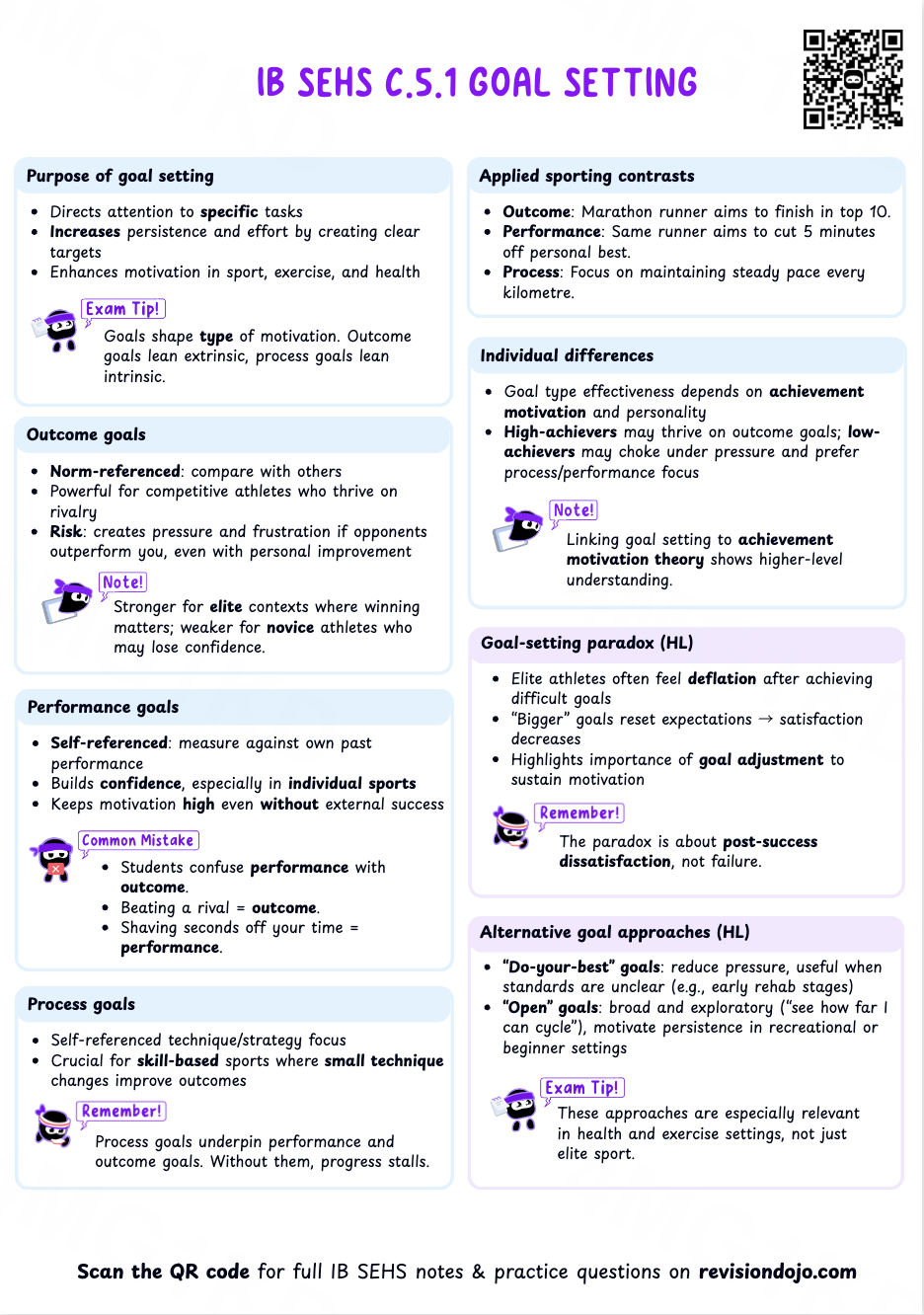
Goal setting is a fundamental psychological skill used to direct an individual's attention and effort towards a specific objective. In sport, exercise, and health, it is a powerful tool for enhancing motivation, providing feedback, and supporting long-term adherence to a training or activity program.
The key concepts in goal setting are:
- Outcome goals p.50
- Performance goals p.50
- Process goals p.50
These different goal types work together to influence an athlete's focus and motivation through the following mechanism:
- Outcome goals provide the ultimate direction and long-term vision (e.g., winning a championship). However, as they are often dependent on the performance of others, they are not entirely within an individual's control.
- Performance goals shift the focus to achieving a self-referenced standard (e.g., a personal best time). This increases an individual's sense of control and allows for more objective measurement of progress, independent of opponents.
- Process goals are the most controllable, as they direct attention to the specific actions, techniques, or strategies required to execute a skill effectively. They are the building blocks that lead to the achievement of performance and outcome goals.
A basketball player aiming to improve their free-throw shooting could use a combination of goals:
Outcome Goal: To have the highest free-throw percentage in the league.
Performance Goal: To achieve a free-throw percentage of 85% for the season.
Process Goal: To bend their knees, keep their elbow tucked in, and follow through on every shot.
The effectiveness of each goal type depends on the individual and their achievement motivation. Some athletes are highly driven by norm-referenced outcome goals, while others perform better when focusing entirely on self-referenced performance and process goals. p.50
C.5.1.2 Goal Setting (HL Only)
For Higher Level students, the study of goal setting becomes more nuanced, exploring the potential downsides and the critical importance of flexibility. This includes understanding paradoxical effects on elite performers and the necessity of adjusting goals in dynamic performance environments.
Key HL concepts include:
- The goal-setting paradox p.50
- Goal adjustment p.50
- "Do-your-best" or "open" goals p.50
The goal-setting paradox describes a counterintuitive psychological response sometimes seen in elite athletes. The mechanism is as follows:
- An athlete sets an extremely high, long-term goal that requires immense dedication and sacrifice to achieve.
- Upon finally achieving this pinnacle goal, instead of pure elation, they may experience feelings of deflation, emptiness, or a loss of purpose.
- This is because the entire process was focused on the destination, and once reached, the journey and its driving motivation are abruptly over. This highlights why goal adjustment and setting new goals are critical for sustained well-being.
Consider an elite marathon runner who sets a performance goal of a sub-2:15:00 time. On race day, they encounter unexpectedly strong headwinds. Instead of rigidly sticking to their initial pace, which could lead to burnout, they engage in goal adjustment. Mid-race, they shift their focus to a process goal of maintaining a specific effort level (e.g., heart rate zone) and adjust their performance goal to finishing in the top five, demonstrating the adaptive nature required at the elite level.
While structured goal setting is widely promoted, it is important to recognize that it is not a panacea. Research suggests that for certain tasks or individuals, less rigid "do-your-best" goals or "open" goals (which have no predefined endpoint) can lead to superior performance and creativity. p.50
C.5.2 Imagery (HL Only)
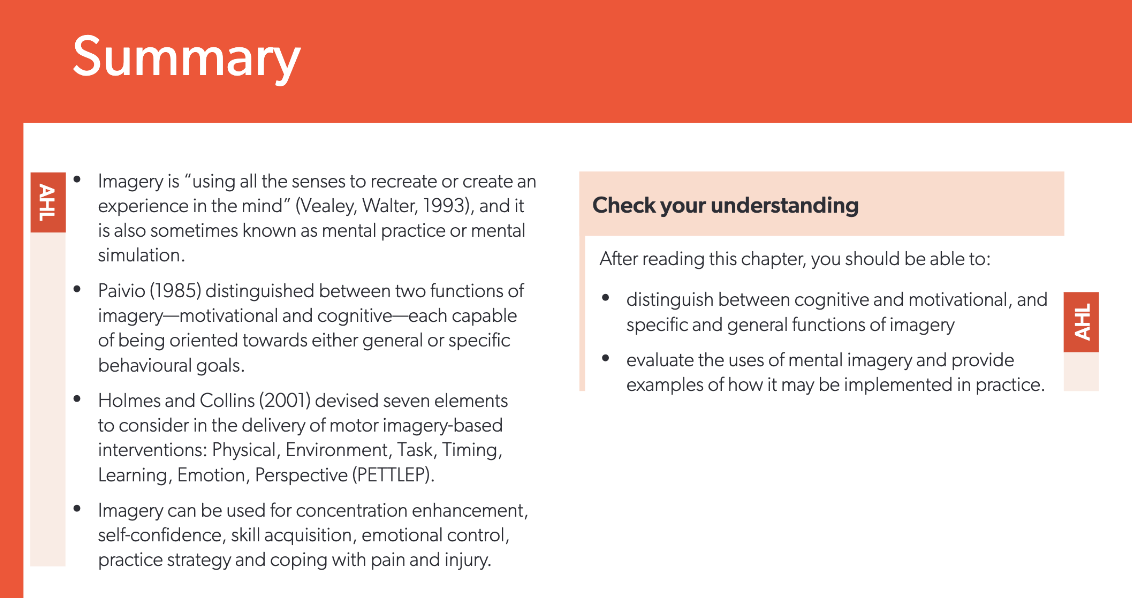
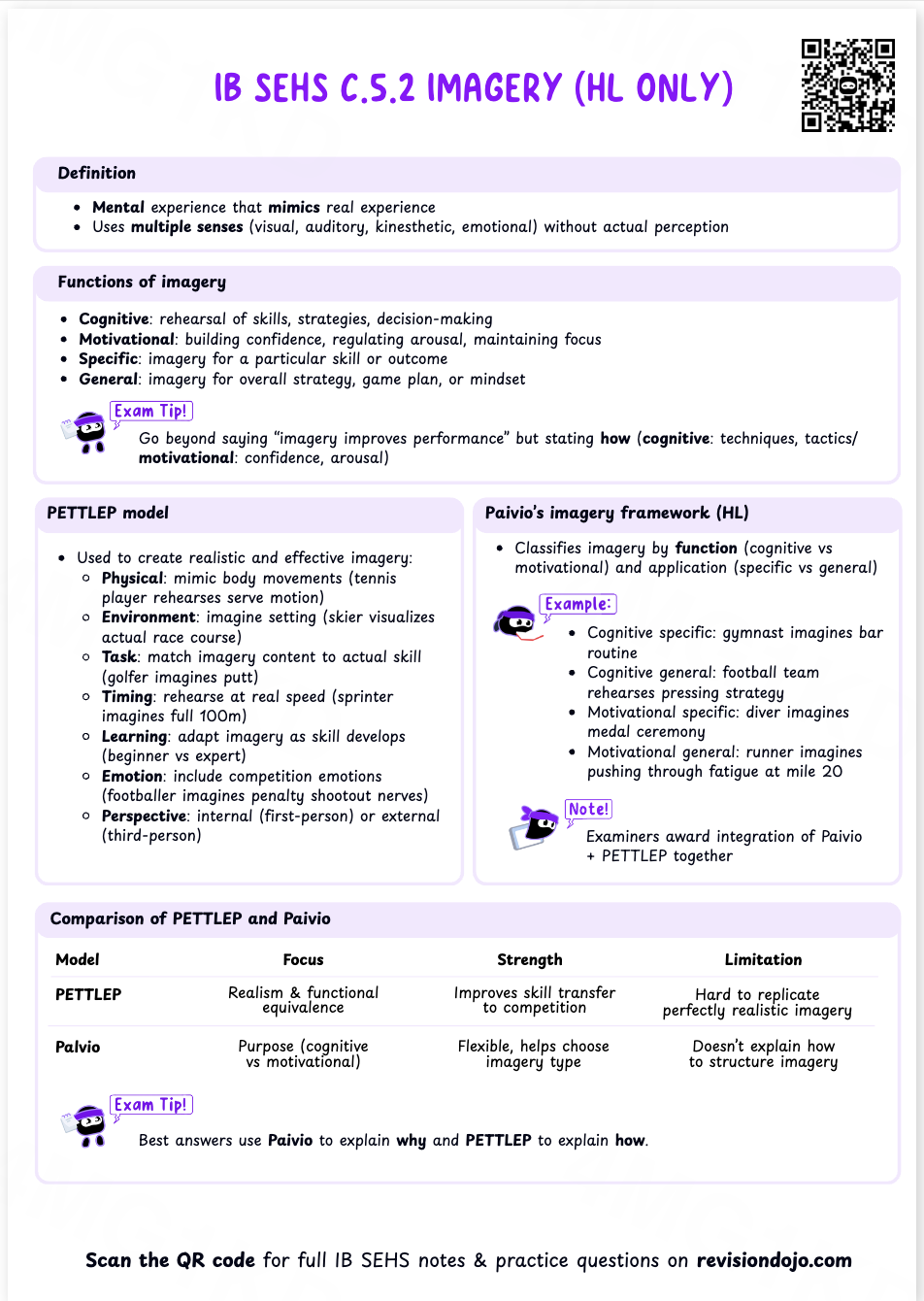
Imagery, often referred to as visualization or mental rehearsal, is a cognitive process that mimics a real experience. It is a powerful psychological skill that involves using a combination of sensory modalities (sight, sound, touch, etc.) in the absence of actual perception. In sport, it serves two primary functions: a cognitive function (to rehearse skills and strategies) and a motivational function (to manage arousal and build confidence).
Key concepts in imagery include:
- Cognitive and motivational functions p.50
- The PETTLEP model p.50
- Paivio's imagery framework p.50
To be effective, imagery must be more than simple daydreaming. The PETTLEP model provides a framework for creating a vivid and realistic mental script that is functionally equivalent to the actual performance. Each element contributes to this equivalence:
- Physical: The imager should adopt the physical stance and wear the same attire as in the performance environment.
- Environment: The imager should visualize the specific competition venue, including the sights, sounds, and textures.
- Task: The content of the imagery should be identical in its demands and focus to the actual task being performed.
- Timing: The imagery should be conducted in real-time, taking the same duration as the actual skill or performance.
- Learning: The imagery content should be adapted as the athlete's skill level and needs change over time.
- Emotion: The imager should attach the emotions and feelings that would be associated with the real performance (e.g., confidence, determination, managing anxiety).
- Perspective: The imager can switch between an internal (first-person) and external (third-person) perspective, depending on what is most effective for the task.
A gymnast preparing for a major competition could use the PETTLEP model to mentally rehearse their floor routine. They would sit quietly in their competition leotard (Physical), vividly imagining the specific arena, the crowd noise, and the feel of the floor (Environment). They would mentally perform the exact sequence of tumbles and dance elements (Task) in the same 1 minute and 30 seconds it takes in reality (Timing). They would focus on a new, difficult tumbling pass they have recently perfected (Learning), while generating feelings of confidence and control (Emotion). They would see the routine from their own eyes (Perspective - internal) to feel the movements and from a judge's perspective (Perspective - external) to check their lines and form.
Imagery is fundamentally about creating a multi-sensory experience within the mind. Effective imagery engages not just the visual sense but also auditory (hearing the crowd), kinesthetic (feeling the muscle contractions), and emotional systems, all without any external stimuli. p.50
Applying this detailed content knowledge to exam-style questions is the next critical step in your preparation.
This section provides an opportunity to apply your understanding of Topic C.5. As the source context does not contain official past paper questions for this topic, the following questions are illustrative examples. They have been created to reflect the style, structure, and rigor of IB SEHS assessments, based exclusively on the 2026 syllabus content.
Why A is wrong: This is an outcome goal, as it is norm-referenced and dependent on the performance of other competitors.
Why C is wrong: This is a process goal, as it focuses on the specific technique required to execute the swimming stroke effectively.
Why D is wrong: This is an outcome goal, as it is a result that is not entirely within the athlete's control and depends on selectors' decisions.
(Source: Illustrative question based on syllabus content, p.50)
Why A is wrong: Goal adjustment refers to the process of changing goals, not the feeling after achieving one.
Why B is wrong: The overjustification effect relates to extrinsic rewards diminishing intrinsic motivation, which is a different concept.
Why D is wrong: Learned helplessness relates to a perceived lack of control over future outcomes, not a response to success.
(Source: Illustrative question based on syllabus content, p.50)
Why A is wrong: Paivio's framework categorizes the function of imagery (e.g., cognitive, motivational) rather than providing a structure for its application.
Why B is wrong: The Inverted U Theory relates arousal to performance, it is not a model for imagery.
Why C is wrong: The Information Processing Model is a theory of motor learning, not an imagery framework.
(Source: Illustrative question based on syllabus content, p.50)
Why A is wrong: Cognitive Specific imagery is used for rehearsing specific skills, such as the technique of a free throw, not for boosting confidence about an outcome.
Why B is wrong: Cognitive General imagery is used for rehearsing strategies, such as a team's offensive play.
Why D is wrong: Motivational General imagery is used to regulate arousal and affect, such as imagining staying calm under pressure.
(Source: Illustrative question based on syllabus content, p.50)
The questions below provide insight into the types of challenges you will face in Paper 1B. Unlike standard knowledge checks, this component places a distinct emphasis on data analysis and experimental work.
Success in Paper 1B requires you to apply the "Nature of Science" (NOS) skills—such as evaluating methodologies, interpreting graphs, and understanding study design—rather than simply recalling course content.
To access a complete archive of true past papers and exemplar materials for Paper 1B, please use the resource link below.
A study was conducted to investigate the effect of different goal-setting strategies on the performance of novice archers. Group A was instructed to focus only on an outcome goal (hitting the bullseye). Group B was instructed to focus on a process goal (maintaining a smooth release). Their average scores over 50 attempts were recorded.
| Group | Goal-Setting Strategy | Average Score (out of 10) |
|---|---|---|
| Group A | Outcome Goal | 6.2 |
| Group B | Process Goal | 8.1 |
State which group had the higher average score. [1 mark]
Describe the effect of focusing on a process goal compared to an outcome goal on the archers' performance, using the data. [2 marks]
Explain why the process-goal strategy likely led to a better performance for these novice archers. [2 marks]
A sport psychologist investigated the relationship between goal achievement and satisfaction in elite athletes. Athletes rated their satisfaction on a 1-10 scale immediately after achieving either a moderately difficult training goal or a highly difficult championship goal.
| Goal Type | Mean Satisfaction (1-10) |
|---|---|
| Moderately difficult training goal | 8.5 |
| Highly difficult championship goal | 5.0 |
Identify which goal achievement resulted in lower satisfaction. [1 mark]
Describe the relationship shown in the data between goal difficulty and athlete satisfaction. [2 marks]
Explain this result using a relevant psychological concept. [2 marks]
A researcher conducted a study to test if using the PETTLEP imagery model improved the performance of gymnasts on the balance beam. Ten gymnasts from a local club were recruited. For four weeks, they all used a PETTLEP-based imagery script before each training session. Their performance was rated by their coach on a 1-10 scale before and after the four-week period. The results showed an average improvement of 1.5 points.
Outline the purpose of the PETTLEP model. [1 mark]
The study concluded that the PETTLEP intervention was effective. Evaluate the methodology used in this study. [4 marks]
A sports club tracked the primary goal type set by 50 new members at the start of a 12-week fitness program. The table below shows the number of members who completed the program versus those who dropped out, categorized by their primary goal type.
| Primary Goal Type | Completed Program | Dropped Out |
|---|---|---|
| Outcome Goal (e.g., "lose 10kg") | 11 | 14 |
| Process Goal (e.g., "attend 3 sessions per week") | 22 | 3 |
Calculate the percentage of members with a primary process goal who completed the program. [1 mark]
Using the data, compare the effectiveness of outcome goals versus process goals for program adherence in this group. [2 marks]
Explain one reason why a process goal might lead to better adherence than an outcome goal in a fitness program. [2 marks]
Explain why this exclusive focus on an outcome goal may be contributing to her anxiety, and describe how a coach could implement two other types of goals to help manage her anxiety and improve her performance. [4 marks]
(Source: Illustrative question based on syllabus content, p.50)
A coach could implement performance and process goals to help. First, a performance goal, such as "achieving a first-serve percentage of 60% in the match," would shift her focus to a measurable, self-referenced target that is independent of winning or losing. Second, a process goal, such as "watching the ball onto the strings for every shot," would direct her attention to a specific, controllable technical element of her game. By focusing on these controllable goals, her attention is diverted from the high-pressure outcome, reducing anxiety and allowing her to concentrate on the actions that will ultimately lead to better performance.
Explain, with clear examples for each component, how the diver could use the PETTLEP model of imagery to mentally prepare in the moments before their dive. [6 marks]
(Source: Illustrative question based on syllabus content, p.50)
Physical: They would stand in the correct pre-dive stance, tensing the same muscles they will use, feeling the texture of the diving board with their feet.
Environment: They would visualize the specific pool, the height of the board, the position of the judges, and hear the sound of the crowd.
Task: The imagery would focus on the specific dive they are about to perform, including the hurdle, takeoff, tuck, and clean entry into the water, with the correct attentional focus.
Timing: The entire mental rehearsal of the dive would be performed in real-time, taking the same few seconds as the actual dive.
Learning: The diver would focus on a key technical point they have been working on in training, such as maintaining a tight tuck.
Emotion: They would attach feelings of confidence, control, and calmness to the imagery, replacing feelings of anxiety with the emotions associated with a successful dive.
Perspective: They could use an internal perspective to feel the movement and rotation, and briefly use an external perspective to see their body position and form as a judge would.
Having applied your knowledge, we will now clarify the mathematical requirements for this topic.
Topic C.5 is a qualitative topic that focuses on psychological theories and interventions. Unlike topics such as B.2 or C.4, it does not involve specific numerical formulas or calculations. Instead, your "mathematical" focus should be on interpreting the logical structure of psychological frameworks and applying them to qualitative data analysis.
Awareness of common misconceptions and errors is a key step towards avoiding them in your own work. Since the source context does not provide specific examples of documented student errors for Topic C.5, this section outlines potential areas of confusion based on the syllabus content.
The IB SEHS course is designed to be a cohesive whole. The ability to make connections between different areas of the syllabus is a hallmark of a high-achieving student.
Thinking points:
- Consider the "big five" personality traits. An individual high in conscientiousness may respond very well to structured goal setting.
- An individual high in neuroticism might find ambitious outcome goals to be a source of anxiety.
- Consider achievement motivation (need for achievement vs. need to avoid failure).
Thinking points:
- Macrocycles aligned with long-term outcome goals.
- Mesocycles linked to specific performance goals.
- Microcycles structured around specific process goals.
Thinking points:
- Psychological skills like imagery can manage cognitive anxiety (C.4.1).
- This directly influences the autonomic nervous system balance (A.1.1).
- Reduction in sympathetic activity leads to lower heart rate (A.1.2).
- Can I define and provide a clear sporting example for outcome, performance, and process goals?
- Can I explain the mechanism through which different goal types direct an athlete's attention?
- Can I explain why the effectiveness of goal setting can vary based on individual differences?
- (HL) Can I describe the goal-setting paradox?
- (HL) Can I explain why goal adjustment is critical?
- (HL) Can I define imagery and differentiate its functions?
- (HL) Can I explain all seven components of the PETTLEP model?
🎉 Topic C5 - Psychological Skills Mastered!
You have completed the comprehensive study guide for Topic C.5.